
Chronic illness takes a huge toll. I have witnessed its impact on the lives of many of my clients, my parents, and numerous friends and family. For those afflicted with a chronic medical condition, it often takes a toll on their very quality of life—impacting everything from daily activities, to work, to relationships, to finances, to independence and autonomy.
Chronic medical conditions also create a huge societal toll. In the US, we are facing a large-scale health crisis. It affects our country’s economic well-being, as we spend huge amounts on medical care. In fact, the US spends more per capita on health care than any other nation, double that of other industrialized nations. Despite our higher health care spending, Americans have lower life expectancy than other high-income nations.
Cardiovascular disease, in particular, has become epidemic in the US. Over 75 percent of people between ages sixty to seventy-nine, and 90 percent of those over age eighty, are afflicted with some form of cardiovascular disease, according to the American Heart Association (see article by AARP). And research suggests that heart disease often starts when we are young, long before we see any signs of its progression.
Early in my career as a psychologist, I learned about the power of mindset, stress management, exercise, and other lifestyle factors for influencing health, but I had little understanding of the role of nutrition. When I first learned about research by pioneers such as Drs. Neal Barnard, T. Colin Campbell, Dean Ornish, and Caldwell Esselstyn, showing the healing power of a plant-based diet to prevent and reverse many common lifestyle diseases, I was blown away. (See my Plant-Powered Resource page for a list of books and resources that share this research).
Since I have a strong family history of heart disease, I was especially impacted by learning that Drs. Ornish and Esselstyn have shown that even severe coronary heart disease can be reversed (and prevented) through a low fat, plant-based diet. Learning that we aren’t solely at the mercy of genes, circumstances, or the medical system, and that we can take charge of our own health, was eye-opening and empowering.
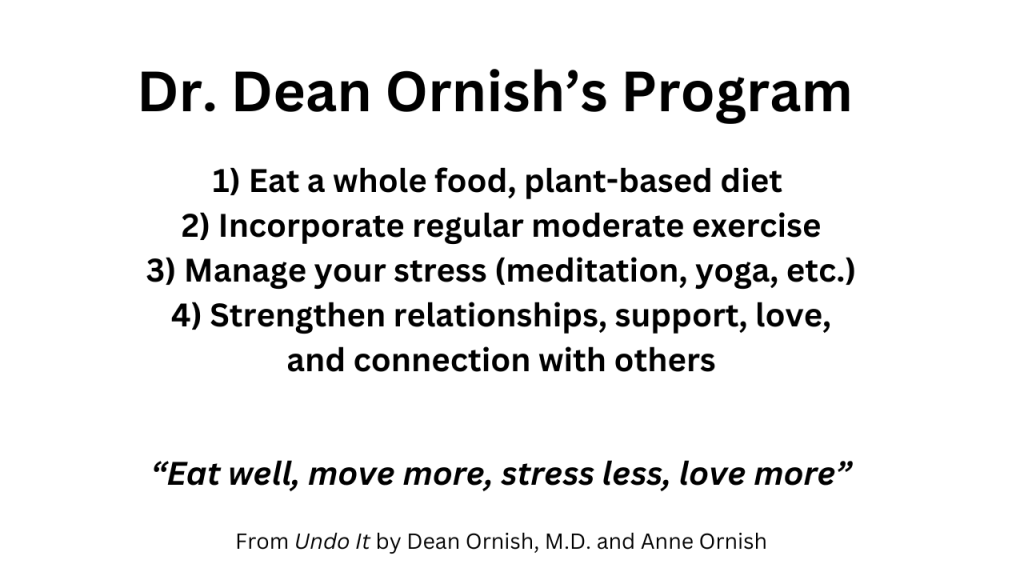
Dr. Dean Ornish has conducted revolutionary research, since the 1980’s, showing that a healthy lifestyle, centered around a plant-based diet, stress management, exercise, and social support, can reverse coronary artery disease, even among those with advanced cases. In addition to improvements in his patients’ physical symptoms, functioning, and well-being, scans of their blood vessels showed reduced blockage and improved blood flow. (For more about Dr. Ornish’s programs and research, read his book, UnDo It, or check out his website).
Similarly, Dr. Caldwell Esselstyn, Jr. conducted research examining the effects of a whole food, plant-based diet for patients with severe coronary artery disease. He found that patients who followed a low fat, plant-based diet showed significant reductions in total cholesterol, LDL cholesterol, coronary events and symptoms, and also evidenced reductions in blockages in their arteries. These improvements enabled his patients to return to previously enjoyed activities and regain their quality of life. (See Prevent and Reverse Heart Disease by Dr. Esselstyn to learn more.)
After my father went through cardiac bypass surgery, I sent him a copy of Dr. Dean Ornish’s cookbook. I don’t think he ever tried the recipes, or significantly changed his diet, although he seemed to appreciate my intentions. (And unfortunately, I lived too far away to share healthy plant-based meals with him on a regular basis). His cardiovascular disease progressed, leading to additional procedures and surgeries. It was heartbreaking to see the impact of these health issues on his life, activities, and independence. My grief was compounded by both parents passing at a younger age than I anticipated due to lifestyle related diseases. Even though I was an adult when I lost them, I felt very much like an orphan after their deaths.
I believe that the loss of my parents played a role in my own desire to be as proactive as possible with my own health, so that I can remain independent, vibrant, and healthy for as long as possible. I have come to realize that we have significantly more personal power over our health than many of us have been told. Rather than clogging our arteries with the Standard American Diet (SAD diet), we can make healthy dietary choices that improve our well-being and decrease our risk for degenerative, lifestyle diseases.
One of the stories I share in my forthcoming book (The Vegan Transformation: A Journey to Heal Yourself and the World) is that of Dr. Akil Taher, a physician, author, and motivational speaker. Dr. Taher began experiencing chest pain in his fifties. Medical testing revealed severe coronary artery blockages, which were addressed by placing stents. Six years later, when the arteries had become narrowed again, he underwent cardiac bypass surgery at age 61. This pivotal experience ultimately led him to adopt a whole-food, plant-based diet. Dr. Taher’s book, Open Heart, chronicles his journey from “couch potato” to running marathons and mountain climbing. His example highlights the profound impact of plant-based diet, mental and emotional resilience, spiritual growth, and finding life’s purpose. He now educates people on preventing and addressing the causes of chronic diseases, rather than treating the consequences of disease after it has happened. (See Dr. Taher’s website to learn more).
It’s empowering to realize that we have more personal power over our health than we have been taught. While we can’t necessarily avoid all illness, we can become informed and make lifestyle choices that support our health. Since learning these connections, it has been part of my mission to empower myself and others toward better physical, emotional, and spiritual health, through the power of a plant-powered, vegan lifestyle.
This passion is one of the reasons I became a licensed PCRM Food for Life instructor and now offer classes on plant-based cooking and nutrition for my online and local communities. Food for Life (FFL) classes promote healthful eating based on the latest scientific research, to help participants reduce their risk for diet-related diseases such as heart disease, diabetes, and cancer. FFL is offered through Physicians Committee for Responsible Medicine (PCRM), a national nonprofit organization that promotes preventive medicine, particularly good nutrition.
Many of us have never learned the power of plant-based nutrition and other healthy lifestyle changes to improve our health and well-being. Once we learn the WHY and the HOW of a healthy, plant-based lifestyle, it can transform our health and our life.
Our health and well-being are among our greatest resources. When we include ourselves in our circle of care, this in turn can empower us to extend our compassion and care to others. Whatever our reasons for moving toward a plant-based lifestyle (whether for personal well-being, animal compassion, and/or the health of our planet), the healthier we are, the greater impact we can have on ALL the things that matter most to us.
NOTE: Segments of this article are adapted from The Vegan Transformation: A Journey to Heal Yourself and the World.
Disclaimer: The information provided in this article and on my website are not intended to be a substitute for professional medical advice, diagnosis, or treatment. Always seek the advice of a qualified health professional with any questions you may have regarding a medical condition. In addition, if you are taking medications for a health condition, it is important to discuss any dietary changes with your physician, as changes in diet may impact the amount of medication needed.
Angela Crawford, Ph.D. is a psychologist, vegan educator, transformational coach, and plant-based culinary instructor. She is author of The Vegan Transformation: A Journey to Heal Yourself and the World (Lantern, April 2025). She also hosts a YouTube channel, @The Vegan Transformation.

 Angela Crawford, Ph.D