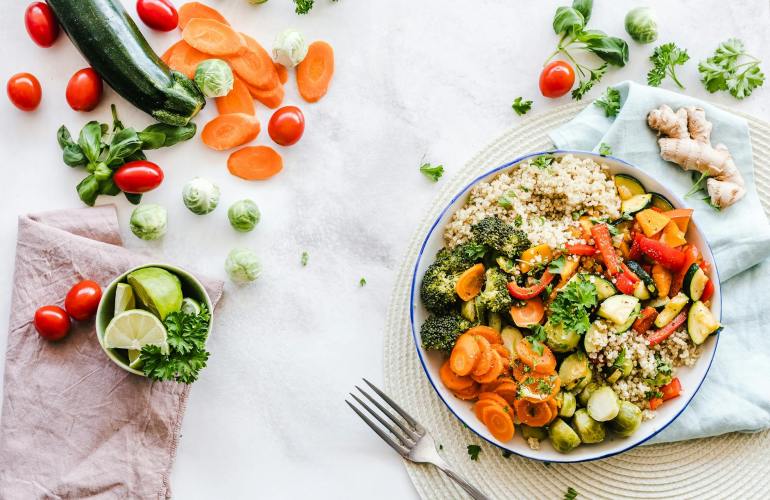
Vegetables on plate

From Comfort Food to Conscious Living: My Journey into The Vegan Transformation

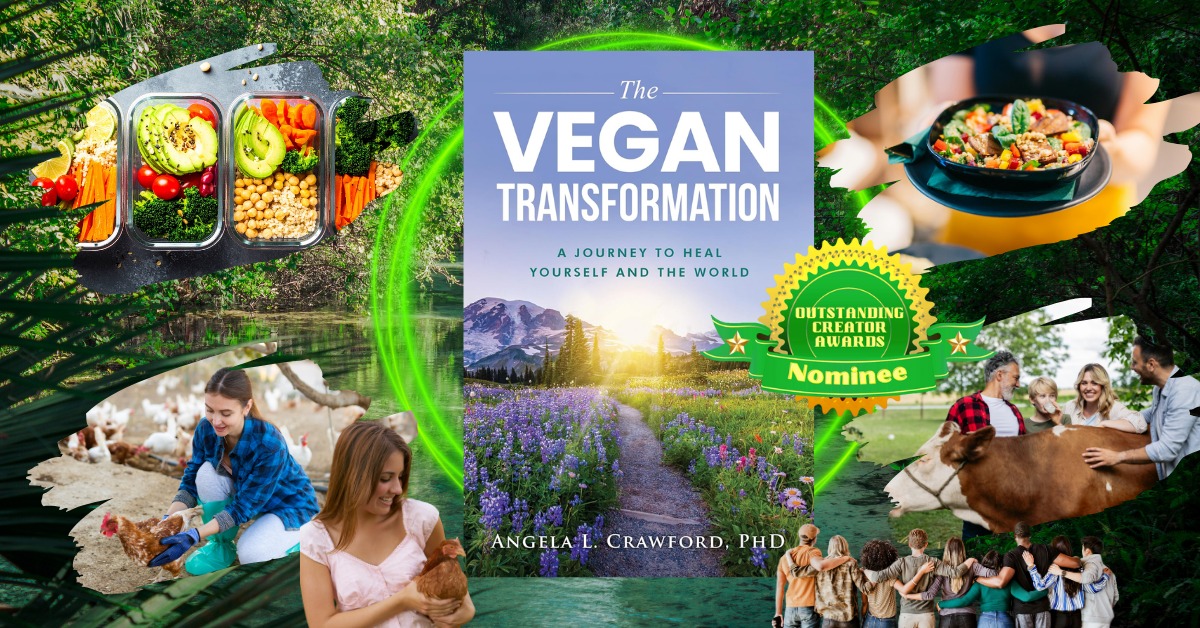
Graphic by Outstanding Creator Awards

Going vegan was a transformation I didn’t see coming.

I grew up in small-town Iowa, in the heart of farm country. I was aware of the farms around me – but had very little awareness of how my food was produced, or the realities of animal agriculture. Plus, I had personal issues that blocked me from looking more deeply…Issues like food addictions and comfort eating. I ate what was convenient, comforting, and tasty. And like many of us, I was confused by the conflicting messages about what was truly healthy.

So even though I was a psychotherapist, empowering clients to make healthy lifestyle changes, I knew little about the power of nutrition – and I myself wasn’t eating in a very healthy way. While I knew it would benefit me to eat more fruits and vegetables, most often I chose frozen microwave dinners, salty snacks, and chocolate bars. In addition, my Midwestern upbringing taught me that meat and dairy were absolute necessities. I had meat for most of my meals, and thought something was missing if it wasn’t there. I thought I needed it for energy, to have enough protein, and to balance out my sugar highs.

Then in late 2006, I had what I think of as my awakening. I saw a program on PBS about working conditions for employees in a meat processing plant, which got me thinking about how my food got to me. Even though the program did not show any gory details about “meat processing,” I felt empathy for the workers and the terrible conditions and injuries they endured. And very soon, this led me to think, “Well, if you don’t like how the workers are treated, what do you think happens to the animals?”  

The very next day, I bought my first plant-based cookbook and cooked my first vegetarian recipe – a spinach, red pepper, and artichoke lasagna. It was delicious – and even though I hadn’t enjoyed cooking before, suddenly it became a fulfilling adventure. I discovered an array of beautiful, colorful, and flavorful plant-sourced ingredients – fruits, vegetables, legumes, whole grains, nuts, seeds, spices and herbs, and all kinds of flavorings and condiments.

I began reading everything I could about the ethical, health, nutritional, and environmental impacts of our food choices. These discoveries led me to go vegetarian within a couple of months of watching this PBS program. Once I understood (and emotionally connected with) the animal suffering and cruelty inherent in factory farming and industrialized slaughter, I just couldn’t eat meat anymore.

Over time, after further reading and watching videos, I came to see all the ways humans harm and exploit animals (e.g., the egg and dairy industries; leather, wool, and down; research and testing; entertainment). Something shifted in me. I broke through my disconnection and dissociation about the animal harm and exploitation in so many industries – and took a stand to do my best not to contribute to this. I made the decision to go vegan in early 2019, and when I did, so much opened up inside of me.

I felt a sense of freedom and lightness that surprised me. I found greater authenticity, a sense of meaning and purpose, and connections with like-hearted others across the globe. I went from being a very private introvert, to being much more willing to be out there in the world, starting a blog and doing public speaking about thriving with a vegan lifestyle.

Even though it was emotionally painful to connect with the suffering of animals – and the reality that many people seem unwilling to make changes that would lessen this suffering – I also felt freer and more empowered when I acknowledged what I must have known deep down. I hadn’t previously realized the weight I felt when eating animal products, but once I shifted to a plant-powered diet, I felt noticeably lighter and more peaceful.

I also felt more empowerment over my personal health and well-being, as I learned about the benefits of a plant-based diet for preventing and reversing many common chronic diseases of our time. Learning about the research of Drs. Dean Ornish and Caldwell Esselstyn showing that a whole food, vegan diet can help to prevent and reverse heart disease was super-empowering, especially given my strong family history of cardiovascular issues.

And somewhat to my surprise, I found it much easier to make healthier food choices. As I ate high-nutrient plant foods on a regular basis (fruits, veggies, legumes, nuts, and whole grains), many of my cravings for addictive and less healthy foods seemed to fade. (I still love chocolate, but find myself satisfied with small qualities of high-quality dark chocolate rather than the large bags of milk chocolate candies that I ate years ago.)

I also discovered that there is a strong connection between what we eat and our emotional well-being. I dove into the research and learned that an anti-inflammatory, high-fiber plant food diet helps to boost our brain, nervous system, and gut health. (You can learn more about this in my recent podcast interview on Food and Mood).

It has been deeply fulfilling to realize how so many things I care about are interconnected. Choosing to honor my compassion by no longer eating animal products also turned out to be an act of compassion for my own well-being, for other humans, and for our planet.

My own transformation – and that of other vegans I met through networking groups – led me to research and write my recently released book, The Vegan Transformation: A Journey to Heal Yourself and the World. I had read a lot about the health benefits of a plant-based diet, and about the ethical reasons for going vegan. But I hadn’t seen much about the emotional and spiritual benefits of this lifestyle. What changes do we experience internally, psychologically, and spiritually when we honor our values and our compassion, and take this road less traveled?

I created an online survey in 2021, which was completed by about 350 vegans. I followed up with 75 in-depth interviews. From these surveys and interviews, I identified seven core transformative pillars: Values alignment; expanding compassion; meaning and purpose; authentic fulfillment; meaningful connections with others; health empowerment; and spiritual deepening. The book shares these pillars, along with stories from my interviewees that illustrate them. I also explain why these transformative themes matter – from the lens of positive psychology, health psychology, and lifestyle medicine.

Learning the stories of other vegans through these interviews and surveys was incredibly uplifting for me – because even though it can certainly be challenging to be vegan in a non-vegan world, it is also deeply fulfilling and healing for many of us. I was struck by how, for many vegans, sharing this lifestyle became central to their purpose and mission.

The year I became vegan, 2019, was dubbed “The Year of the Vegan.” It was an era of heightened interest in vegan and plant-based lifestyles. Right now (in late 2025), the forces of society do not feel so supportive for veganism, even compared to a couple of years ago when I was deep into writing the book. But I continue to hold on to the vision of a compassionate, healthy, vegan world – a world where we end exploitation and unnecessary harm to animals, where we recognize that all sentient beings matter, where we care for one another, ourselves, and our planet.

I invite you to imagine – what would this healthy, compassionate world look like and feel like for you? Take a moment to imagine a world where we are kind to one another and to all beings, where we are healthy in mind-body-spirit, and where we find creative and harmonious solutions to care for the world we live in. Consider how holding that vision daily might uplift you and energize you – even when you face discouraging times and it seems the world will never change. (Here is a link to my guided meditation of “Visioning a Compassionate Vegan World.”)

I truly believe that we are called to expand our circle of compassion – and to bring our unique selves and gifts to serve. We each have something to contribute. And often that starts with our everyday choices – the ones we may have once taken for granted. We come to see that with each meal, and with each conscious and intentional choice, we become – and inspire – the compassionate change we want to see in the world.

NOTE: This article is an adaptation of my presentation for The Vegan Transformation launch celebration. You can watch the presentation on YouTube here.

To learn more about the transformative themes, stories, and research shared in this article, check out my book, The Vegan Transformation, available in paperback, e-book, and audiobook at major booksellers.

The graphic at the top of the page was created by Outstanding Creator Awards, who reviewed The Vegan Transformation and awarded it first place in several categories.
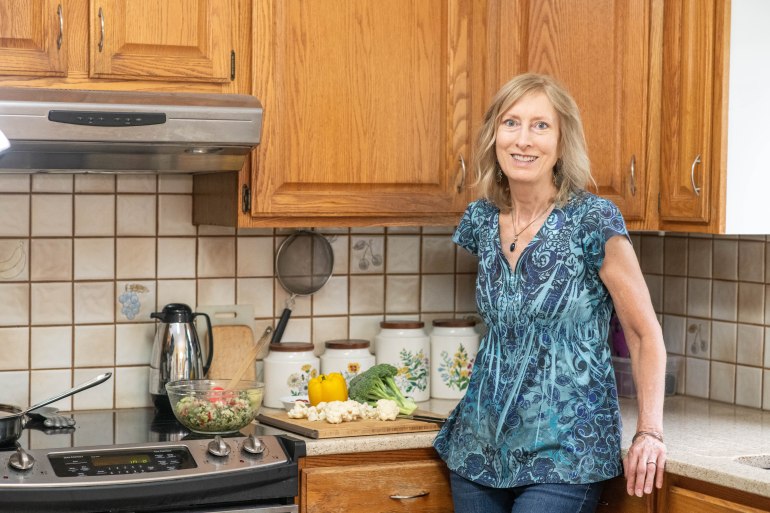
Author standing in kitchen with vegetables on counter

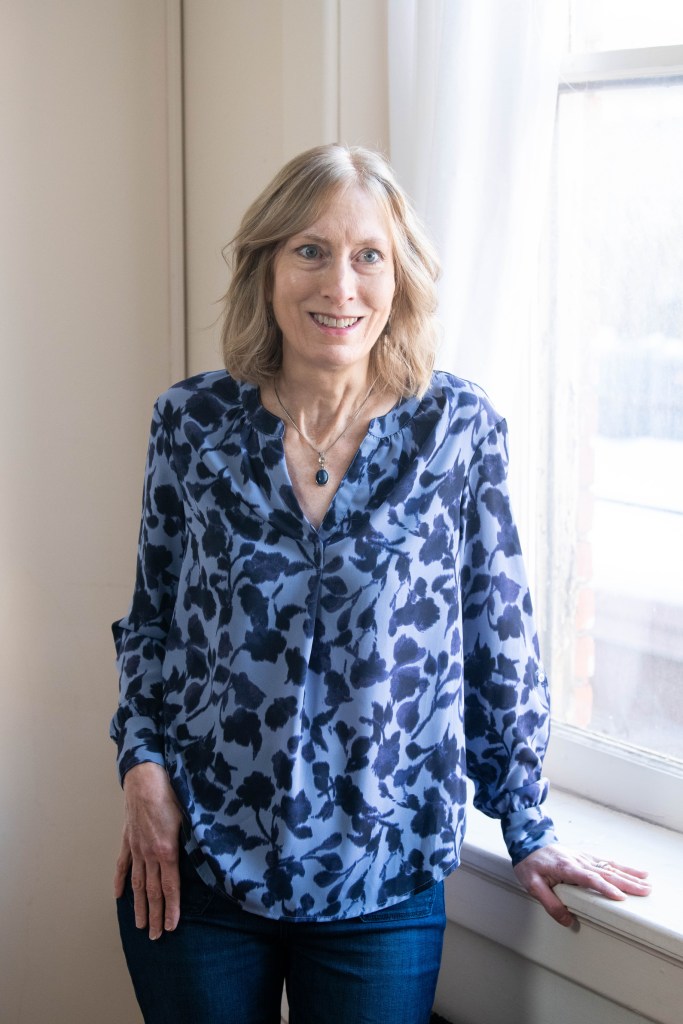
Angela Crawford, Ph.D. is a psychologist, vegan educator, and PCRM Food for Life instructor. She is author of The Vegan Transformation: A Journey to Heal Yourself and the World (Lantern, 2025). The Vegan Transformation is a winner of the Outstanding Creator Awards and Vegan Choice Award, and is available at major booksellers.


Hands forming heart shape with sunset in the background

Plant-Empowered Lifestyle for Heart Health

Hands forming heart shape with sunset in the background
mayur-gala-2podhmrvlik-unsplash

Chronic illness takes a huge toll. I have witnessed its impact on the lives of many of my clients, my parents, and numerous friends and family. For those afflicted with a chronic medical condition, it often takes a toll on their very quality of life—impacting everything from daily activities, to work, to relationships, to finances, to independence and autonomy.

Chronic medical conditions also create a huge societal toll. In the US, we are facing a large-scale health crisis. It affects our country’s economic well-being, as we spend huge amounts on medical care. In fact, the US spends more per capita on health care than any other nation, double that of other industrialized nations. Despite our higher health care spending, Americans have lower life expectancy than other high-income nations.

Cardiovascular disease, in particular, has become epidemic in the US. Over 75 percent of people between ages sixty to seventy-nine, and 90 percent of those over age eighty, are afflicted with some form of cardiovascular disease, according to the American Heart Association (see article by AARP). And research suggests that heart disease often starts when we are young, long before we see any signs of its progression.

Early in my career as a psychologist, I learned about the power of mindset, stress management, exercise, and other lifestyle factors for influencing health, but I had little understanding of the role of nutrition. When I first learned about research by pioneers such as Drs. Neal Barnard, T. Colin Campbell, Dean Ornish, and Caldwell Esselstyn, showing the healing power of a plant-based diet to prevent and reverse many common lifestyle diseases, I was blown away. (See my Plant-Powered Resource page for a list of books and resources that share this research).

Since I have a strong family history of heart disease, I was especially impacted by learning that Drs. Ornish and Esselstyn have shown that even severe coronary heart disease can be reversed (and prevented) through a low fat, plant-based diet. Learning that we aren’t solely at the mercy of genes, circumstances, or the medical system, and that we can take charge of our own health, was eye-opening and empowering.

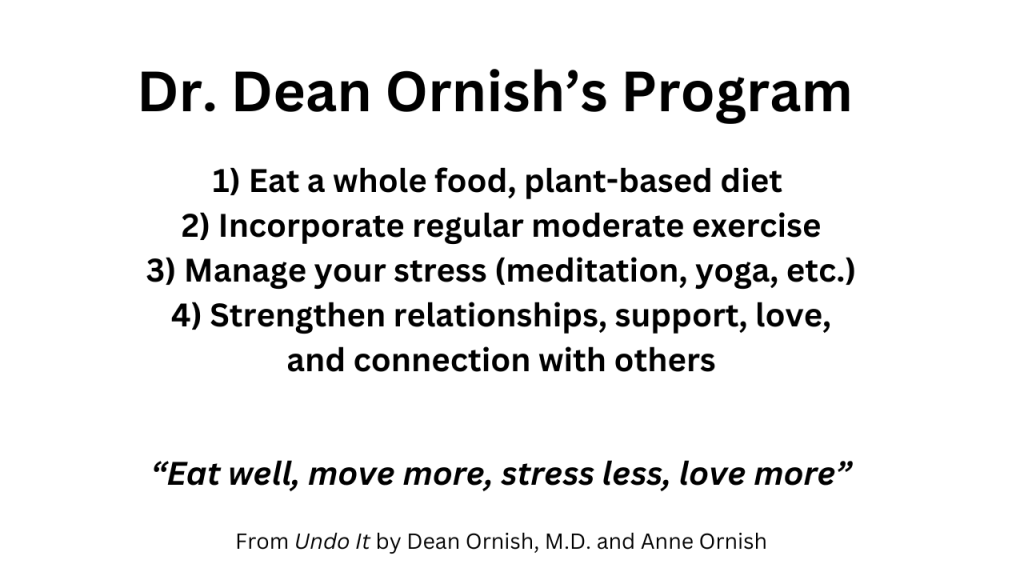
Dr. Dean Ornish has conducted revolutionary research, since the 1980’s, showing that a healthy lifestyle, centered around a plant-based diet, stress management, exercise, and social support, can reverse coronary artery disease, even among those with advanced cases. In addition to improvements in his patients’ physical symptoms, functioning, and well-being, scans of their blood vessels showed reduced blockage and improved blood flow. (For more about Dr. Ornish’s programs and research, read his book, UnDo It, or check out his website).

Similarly, Dr. Caldwell Esselstyn, Jr. conducted research examining the effects of a whole food, plant-based diet for patients with severe coronary artery disease. He found that patients who followed a low fat, plant-based diet showed significant reductions in total cholesterol, LDL cholesterol, coronary events and symptoms, and also evidenced reductions in blockages in their arteries. These improvements enabled his patients to return to previously enjoyed activities and regain their quality of life. (See Prevent and Reverse Heart Disease by Dr. Esselstyn to learn more.)

After my father went through cardiac bypass surgery, I sent him a copy of Dr. Dean Ornish’s cookbook. I don’t think he ever tried the recipes, or significantly changed his diet, although he seemed to appreciate my intentions. (And unfortunately, I lived too far away to share healthy plant-based meals with him on a regular basis). His cardiovascular disease progressed, leading to additional procedures and surgeries. It was heartbreaking to see the impact of these health issues on his life, activities, and independence. My grief was compounded by both parents passing at a younger age than I anticipated due to lifestyle related diseases. Even though I was an adult when I lost them, I felt very much like an orphan after their deaths.

I believe that the loss of my parents played a role in my own desire to be as proactive as possible with my own health, so that I can remain independent, vibrant, and healthy for as long as possible. I have come to realize that we have significantly more personal power over our health than many of us have been told. Rather than clogging our arteries with the Standard American Diet (SAD diet), we can make healthy dietary choices that improve our well-being and decrease our risk for degenerative, lifestyle diseases.

One of the stories I share in my forthcoming book (The Vegan Transformation: A Journey to Heal Yourself and the World) is that of Dr. Akil Taher, a physician, author, and motivational speaker. Dr. Taher began experiencing chest pain in his fifties. Medical testing revealed severe coronary artery blockages, which were addressed by placing stents. Six years later, when the arteries had become narrowed again, he underwent cardiac bypass surgery at age 61. This pivotal experience ultimately led him to adopt a whole-food, plant-based diet. Dr. Taher’s book, Open Heart, chronicles his journey from “couch potato” to running marathons and mountain climbing. His example highlights the profound impact of plant-based diet, mental and emotional resilience, spiritual growth, and finding life’s purpose. He now educates people on preventing and addressing the causes of chronic diseases, rather than treating the consequences of disease after it has happened. (See Dr. Taher’s website to learn more).

It’s empowering to realize that we have more personal power over our health than we have been taught. While we can’t necessarily avoid all illness, we can become informed and make lifestyle choices that support our health. Since learning these connections, it has been part of my mission to empower myself and others toward better physical, emotional, and spiritual health, through the power of a plant-powered, vegan lifestyle.

This passion is one of the reasons I became a licensed PCRM Food for Life instructor and now offer classes on plant-based cooking and nutrition for my online and local communities. Food for Life (FFL) classes promote healthful eating based on the latest scientific research, to help participants reduce their risk for diet-related diseases such as heart disease, diabetes, and cancer. FFL is offered through Physicians Committee for Responsible Medicine (PCRM), a national nonprofit organization that promotes preventive medicine, particularly good nutrition.

Many of us have never learned the power of plant-based nutrition and other healthy lifestyle changes to improve our health and well-being. Once we learn the WHY and the HOW of a healthy, plant-based lifestyle, it can transform our health and our life.

Our health and well-being are among our greatest resources. When we include ourselves in our circle of care, this in turn can empower us to extend our compassion and care to others. Whatever our reasons for moving toward a plant-based lifestyle (whether for personal well-being, animal compassion, and/or the health of our planet), the healthier we are, the greater impact we can have on ALL the things that matter most to us.

NOTE: Segments of this article are adapted from The Vegan Transformation: A Journey to Heal Yourself and the World.

Disclaimer: The information provided in this article and on my website are not intended to be a substitute for professional medical advice, diagnosis, or treatment. Always seek the advice of a qualified health professional with any questions you may have regarding a medical condition. In addition, if you are taking medications for a health condition, it is important to discuss any dietary changes with your physician, as changes in diet may impact the amount of medication needed.

Angela Crawford, Ph.D. is a psychologist, vegan educator, transformational coach, and plant-based culinary instructor. She is author of The Vegan Transformation: A Journey to Heal Yourself and the World (Lantern, April 2025). She also hosts a YouTube channel, @The Vegan Transformation.

Three Tips for Inspiring Healthy Lifestyle Change

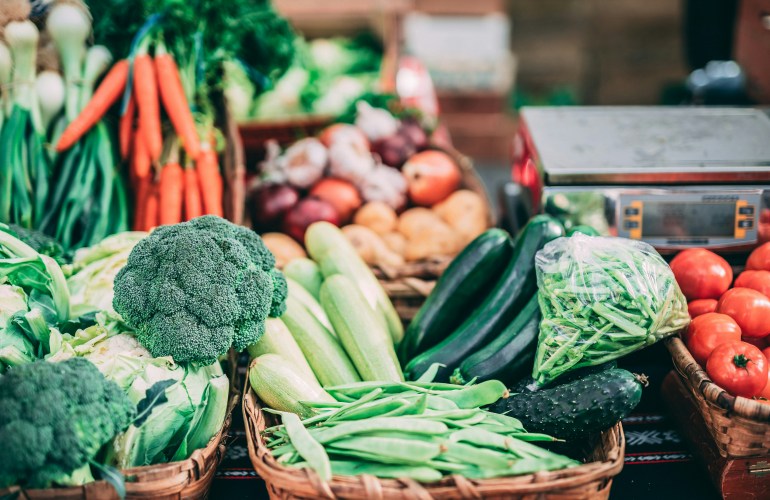
Colorful vegetables
Photo by Iñigo De la Maza on Unsplash

Have you experienced the healing power of a plant-based diet? If so, you are part of a growing movement of people who have discovered the personal and global benefits of eating healthfully, compassionately, and sustainably.

Eating plant-based (and excluding animal products) is compassionate to animals AND supports our health and well-being. A simple dietary change holds the secret to an ethical, environmentally friendly, and healthy life. Those of us who have experienced the myriad benefits of a plant-sourced diet often yearn to spread the positive message to others. This is such a natural feeling. If you’ve discovered a way to change your life for the better, why wouldn’t you want everyone to know about it? By sharing your plant-powered lifestyle with others, you have the power to help people make a positive change in their lives – and to create transformative healing in the world.

The health benefits of a whole plant food diet can include improved immune functioning, preventing and reversing chronic lifestyle disease, greater fitness and endurance, glowing skin, and aging more youthfully. Plant-powered living can also boost our emotional, mental, cognitive, and spiritual well-being.

And yet despite extensive scientific support for these benefits, many of us find that when we try to encourage others toward plant-based living, they tune us out, dismiss us, or become defensive.

How can we inspire others to live healthier lives – and ultimately to create a healthier world? In this article, I share three foundations for empowering positive change.

1. Be a positive role model

Your actions inspire others. It’s easy to underestimate the power of your presence. However, your way of being has more influence than almost anything you say. Embody the lifestyle that you hope to inspire in others. When you are healthy, active, compassionate, and appreciative, this draws others to want to discover your secret. When you gracefully navigate life’s ups and downs, and nourish your mind, body, and spirit, this is magnetizing. And when you genuinely care about helping others – when you are a support, rather than a critic – this opens up greater receptivity in others.

You can be a positive role model through sharing appetizing and healthy vegan food; nurturing your mind-body-spirit wellness; focusing on the positives of vegan/plant-based living; developing a strong support network; and handling life’s challenges proactively and positively.

2. Meet people where they are

Sometimes we expect others to change in the same way (or timeframe) that we did. Or we share the information that interests or motivates us – but which may or may not resonate for the other person. Expecting others to change on our terms is not realistic – and is often counterproductive. Generally, we can have a greater impact if we meet others where they are.

A helpful model for identifying someone’s openness to change is the Transtheoretical Model of Change (also called the Stages of Change), created by psychologists James Prochaska and Carlo DiClemente. The primary stages of change are: Precontemplation, Contemplation, Preparation, Action, and Maintenance. Developed to better understand the process of behavior change, it applies to all types of lifestyle change – including the transition to a plant-based lifestyle.

If you are talking to someone who is in Precontemplation, generally they are not interested in or ready to consider a plant-based lifestyle. This may be a hardcore meat eater, or someone who just doesn’t see a reason for lifestyle change. This doesn’t mean you can’t have an influence on them – but you will need to approach them differently than someone who has more interest or openness. In this stage, you may focus more on being a positive role model and inspiring their curiosity through your example. Also, be on the lookout for moments of greater receptivity. Learn more about their interests and concerns so that when appropriate, you can offer tidbits of relevant information or stories that may spark their interest. This may help them move toward the next stage of readiness, Contemplation.

In the Contemplation stage, they are considering moving toward a plant-based lifestyle. However, they are still on the fence, going back and forth about the pros and cons. You may support them to move forward by sharing the positives of plant-powered living, raising awareness of the costs of not changing their lifestyle, and empowering their confidence to take first steps.

When a person decides they are ready for change, they move into Preparation. In this stage, they begin to lay a foundation for action. They are likely to be eager for resources and information to help them move forward. This is the stage when they will most benefit from direct support, resources, guidance, and encouragement so they can successfully prepare for and take initial steps toward a healthy, plant-based lifestyle.

In Action, they are now living a plant-based lifestyle and discovering the skills and habits to nurture and sustain in daily life. They are still early on their journey, and will likely benefit from support, resources, and guidance to strengthen skills for plant-based living, overcome challenges, and maintain their momentum.

Those in Maintenance have sustained lifestyle change for six months or more. In this stage, they may face specific challenges (such as travel or social situations) where they need support and guidance. In addition, they will benefit from connecting with others who share their passion and nurture their commitment.

Recognizing the other person’s level of readiness for change can help immensely in discovering how to best connect with them and inspire steps forward.

3. Build bridges of connection

The third principle for supporting change is to create positive connections with those you want to inspire. Adopting a new lifestyle requires learning new habits, overcoming old beliefs and practices, and developing a new way of being. It can be more difficult to learn skills and create lasting change when we feel threatened or unsafe. Think about meaningful changes you’ve made in your life. Most likely, they weren’t the result of someone beating you over the head or trying to make you feel like a bad person. Usually, we change because something brought new insight or awareness – and because change felt like the right thing to do.

Thus, to empower others to change, we need to create a safe relational space for learning and growth. Judgment or contempt will trigger the other person into fight-or-flight mode, where the primary focus is self-protection and defense. In contrast, creating an atmosphere of calm, curiosity, care, and connection can open the door for new possibilities and actions.

How do we create these kinds of transformative connections? One helpful practice is intentionality. Before you have a conversation with someone, clarify your intentions. The authors of Crucial Conversations suggest asking yourself questions such as: What do you want for yourself, for the other person, for the relationship, and for the larger picture? And how can you best communicate to create that outcome? Being intentional connects you with your Wise Brain so that you express yourself effectively – not reactively.

An important foundational intention is to create mutual understanding. Even if you see things very differently, you will have more impact if you seek to understand the other person’s point of view and what matters to them. And they will be more open to understanding your perspective when they feel your true interest in them (without an agenda to push change they aren’t ready for or open to).

It’s also helpful to share positive and encouraging messages. Share how your life has been positively impacted through plant-based living. Encourage them in any steps they are taking toward greater health or compassion. Highlight and reinforce behaviors you hope to strengthen versus criticizing what is “wrong” or lacking.

Finally, focus on planting seeds of change. For most of us, many seeds are planted before we start or sustain a vegan/plant-based lifestyle. On my own journey, in retrospect, I now see many experiences that increased my readiness for change. First, it was eating delicious plant-based meals at a conference that made me realize that this lifestyle could be doable. A couple of months later, my stepdaughter ate only the vegetarian dishes at our family Thanksgiving. Again, seeds of possibility were planted. It was only a month or so after these events that I saw a program about meat processing plants that led me on the journey toward plant-based eating. Over time, I tried new recipes and expanded my food palette with delicious veg meals. In addition, I read all the books I could about the ethical and health aspects of our food choices. What I discovered led me to become vegetarian, and ultimately, vegan.

As you strive to empower others toward healthy, compassionate lifestyle choices, it’s important to remember: Just because someone doesn’t change immediately, it doesn’t mean that your words or example didn’t make a difference. Consider that perhaps seeds of possibility are being planted that will take root when the time is right. As more seeds of transformation are cultivated, we nurture a global movement toward greater health, kindness, compassion, and sustainability.

NOTE: This article is based on my presentation for The Science of Staying Young and Thriving: Experts Reveal the Fountain of Youth. To watch the full presentation / webinar on YouTube, CLICK HERE. My presentation is about 10 minutes into the webinar. The full webinar offers wonderful insights from plant-based doctors and leaders about the benefits of plant-based diets for youthful aging.

Angela Crawford, Ph.D. is passionate about the power of a plant-powered, vegan lifestyle for human health; emotional well-being; compassion for all sentient beings; and caring for our planet. She recently researched and wrote a book on the transformative impact of a vegan lifestyle for mind, body, and spirit, due to be published in 2025.

She holds a doctorate in Clinical Psychology and previously worked as a psychotherapist for over two decades. She holds certifications in Plant-Based Nutrition, as a Master Vegan Lifestyle Coach and Educator, and Transformational Coach.

The Transforming Effects of a Plant-Powered Vegan Lifestyle

Photo by Robert Lukeman on Unsplash

Highlights from my interview on the Healthy Lifestyle Solutions Podcast

I had the honor of being interviewed on the Healthy Lifestyle Solutions Podcast with Maya Acosta.  We discussed my vegan journey, the transformative effects of a plant-powered lifestyle, and how to inspire healthy lifestyle change.  We also discuss definitions of vegan and plant-based, and reasons for a vegan lifestyle. Below are some excerpts from the interview.

Tell us about your journey to a plant-based, vegan lifestyle

For most of my life, I was not a healthy eater.  I ate a lot of comfort foods, microwave meals, sweets, and processed foods.  I didn’t like to cook.  Although I exercised a fair amount, I didn’t eat a lot of fruits and vegetables. 

What opened my eyes and led me to eating more plants was when I learned about how animal agriculture works.   I saw a TV program about workers in a meat processing plant, and many of them were immigrants. They had frequent injuries from this difficult work, and were so financially vulnerable that they couldn’t speak up.  They didn’t have power in this system.  It made me think about how my food got to me.  At that time I was working in a pain management program that helped injured workers. That TV program made me think about what meat processing workers were going through.

And then I started to think about all aspects of it, including the treatment of animals and what was actually going into my body when I ate animal-based foods.  I started reading everything I could. I went to the library and read every book on vegetarianism and veganism.  I learned about the health benefits for reversing heart disease from Dr. Dean Ornish and Dr. Caldwell Esselstyn.  That really hit home for me because I have a strong family history of heart disease.  I learned about the impact of animal agriculture on animals and the environment.

After watching that program, I started cooking. The very next day, I bought my first vegetarian cookbook, and made vegetarian lasagna.  I had to buy all these new pots and pans because I never cooked.  It was a great experience and I found that I loved to cook – once I switched to plant-based. 

So many doors opened.  I tried new spices. I tried new ingredients that I’d never thought of before.  I started trying a new recipe or two every week. And over time, I gave up meat entirely. A few years later I started to give up dairy and eggs.  I found that after releasing dairy from my life, my seasonal allergies – that I thought I would always have – just went away.  Some skin conditions that I struggled with went away too. 

So here I am 15 years later, in my mid 50’s, with good health and a lot of energy. I feel good about the way I’m eating, knowing that it is kinder to animals, the planet, and my own health. So it feels good on all levels.  And now my food choices are so much more varied and interesting and nourishing than they used to be.  I would never go back.   

(To read more about my vegan journey, check out my blog article:  How Veganism Inspired Me to Find My Voice.)

What is the difference between vegan and plant-based?

Veganism at its core is an ethical way of living that seeks to avoid harm or exploitation to animals.  People who identify as vegan avoid buying anything that has animal products, including food and other items as well (clothing, shoes, household items, cosmetics, etc).  

A vegan diet excludes all animal products (meat, fish, dairy, or eggs).  A vegan diet can vary in terms of healthiness.  For example, fruits and veggies and beans are vegan, but so are Oreos and potato chips.  In general, a vegan diet that favors whole plant foods (fruits, vegetables, mushrooms, whole grains, legumes, nuts, and seeds), with fewer processed foods, brings optimal health benefits.

A plant-based diet is a more general term, often used interchangeably with vegan diet.  Most often, it refers to a plant-exclusive diet. However, it should be noted that sometimes the term “plant-based” can refer to a diet that is predominantly plant-based (e.g., 80% to 90%). 

A whole food plant-based (WFPB) diet is a plant-exclusive diet, focused on whole plant foods, as minimally processed as possible.  This way of eating has been associated with health benefits, and is high in nutrients, antioxidants, and fiber.

Why do people choose a plant-based (plant-exclusive) lifestyle?

One reason is health.  Eating more plants (and eliminating animal products) helps to prevent and even reverse certain diseases that are common in Western countries, like heart disease, diabetes, certain forms of cancer, and autoimmune disease.  Plant-powered nutrition also supports better fitness and overall health and energy. 

There are also ethical reasons, which I touched on when sharing my experience of learning about the slaughterhouse workers.  When I realized that I didn’t like how the workers were treated, it occurred to me, well, what about the animals?  So many of us love dogs and cats, but we don’t give a second thought to other animals and what that they go through. When we awaken to realize that cows and pigs and chickens matter too, the obvious choice is to no longer consume animal products, to no longer contribute to the suffering of these sentient beings.

A third reason for becoming vegan is caring for the environment.  Animal agriculture, especially the way it’s expanded into factory farming, has had an increasingly toxic effect on our environment, from the use of land and water, to greenhouse gases, as well as cutting down rainforests to create more feed and grazing space for the animals grown for food. All of that has a huge impact.  One book that I found really helpful is Eat for the Planet by Nil Zacharias and Gene Stone.  The authors show that by eating a vegan diet, you save 1500 gallons of water, 45 pounds of grain, and 30 square feet of forest per day. Simply by eating lower on the food chain, you save all of that, along with lowering your carbon emissions by 50%.

(For more information about the reasons for a vegan lifestyle, check out my resource page Why Vegan?

Tell us about your book research on the transformative effects of a plant-powered, vegan lifestyle.

One thing that really intrigues me as a psychologist is how what we eat affects our mental health, our emotional well-being, and even our spiritual well-being.  I’ve been collecting surveys and doing interviews with vegans on this topic.  My goal with this book to convey the changes in mind, body, and spirit that many people experience as they eat in ways that nourish their body, and that are aligned with the deeper values that they hold.  There’s the nutritional benefit of giving our body the nutrients it needs. And then there are psychological benefits of living aligned with our deepest values — caring deeply for our own health, living lightly on the earth, and causing the least harm to other sentient beings. There are amazing shifts that people are reporting, including more interconnectedness with all of nature.  As we eat in this healthy way, there’s a sense of fulfillment, purpose, and peace in honoring our values through our daily choices.

To listen to the full interview, check out The Healthy Lifestyle Solutions Podcast.

(Note: For this article, the interview transcript was copy-edited and some points expanded upon, to improve clarity).

Angela Crawford, Ph.D. is a psychologist and transformational coach. She is passionate about empowering people to create healthy lives that nurture mind, body, spirit, and planet. Dr. Crawford is certified as a Master Vegan Lifestyle Coach and Educator, and has a Plant-Based Nutrition certificate from the T. Colin Campbell Center for Nutrition Studies at e-Cornell. She is currently doing research for a book on the psychological and emotional benefits of a vegan lifestyle. She serves as a psychology advisor for WeDidIt.Health, an on-line community that shares the benefits of a plant-powered lifestyle.