One of the joys of getting my Vegan Transformation bookready for publication is trying out the recipes that my interviewees submitted – wonderful meals like Black Bean and Sweet Potato Burgers, Couscous Summer Salad, Not Tuna Salad, Sweet Potato Enchiladas, Cauliflower Tabouleh, Basil and Celery Leaf Pesto, Peanut Butter Chocolate Chip Cookies and many more – all so delish.
When I started researching and writing my book about the mind-body-spirit transformation of a vegan lifestyle, I was told by my friends that it absolutely needed to include some plant-based recipes – and I could see their point.
Part of the challenge in considering a plant-based lifestyle – at least initially – is figuring out what to eat. Since so many of our family and social traditions center on animal foods, it can be difficult at first to see another way.
I know that was the case for me before becoming plant-based. My past eating patterns weren’t particularly healthy, and I usually chose what was convenient and comforting. I couldn’t imagine what someone would eat on a plant-based diet. It was only after I enjoyed appetizing vegan cuisine at a conference that I became open to the possibility. Then a few months later, when I saw a program that awakened me to factory farming, I became determined to learn HOW to move to a plant-based lifestyle.
It took me some time to learn the ins and outs of plant-based nutrition and cooking – but it was an adventure that I enjoyed. Eating from the bounty of the plant kingdom has brought me greater health, fulfillment, and peace of mind. It has opened me to many wonderful foods I had never previously considered. It has transformed me from someone who didn’t enjoy cooking to someone who now looks forward to creating delicious plant-based meals that I can share with loved ones.
Rather than being restrictive or depriving, becoming vegan has expanded my food palette. Many of the vegans that I have interviewed in my book research also described greater fulfillment and abundance with their vegan lifestyle.
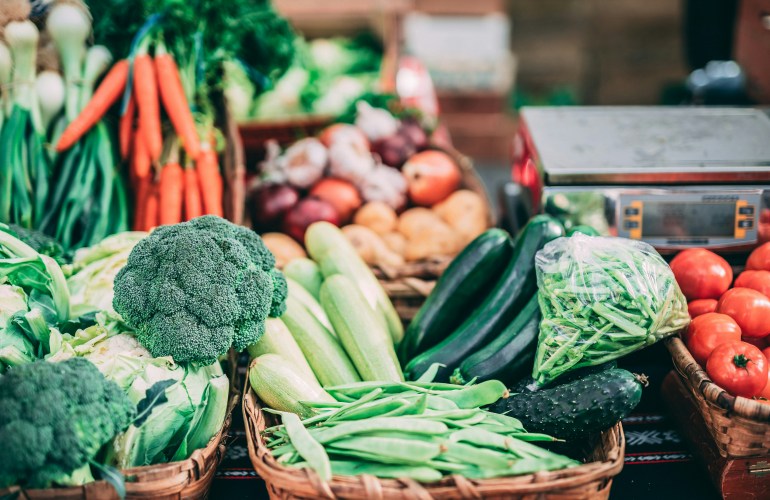
We can especially enjoy this abundance in summer – with fresh fruits and vegetables from the garden, farmer’s market, or produce stand. And we don’t have to give up grilling – there are so many awesome plant options to enjoy on the grill. Not only are there delicious varieties of veggie burgers and hotdogs, you can be creative and try grilled cauliflower, veggie fritters, peppers and onions, portobello mushrooms, eggplant, squash, sweet corn, veggie and tofu kebobs, even pizza. There are also a variety of wonderful salads, chilled soups, and side dishes.
Early on my veg journey, I felt like the odd one out at social events. However, now, plant-based eating seems to be more accepted – and even intriguing – to many people. Recently, when my husband and I hosted a cookout, I was moved that all our guests, even though not vegan, were happy to bring vegan salads and grill foods to the gathering. It was a wonderful experience – and the meal was delicious: Grilled portobello mushrooms, black bean burgers, tabouleh, chickpea and pasta salads, even vegan chocolate cake.
As we enter the Summer Solstice in the Northern Hemisphere, I invite you to explore and enjoy the bounty of summer. To get your creative juices flowing, here is a wonderful article about vegan grilling options: https://grillio.com/blog/vegan…, (shared with me by Ellie and Heather, visitors to my website). You can also find a few summer recipes on my Plant-Powered Recipes resource page, including Beet Burgers, Black Bean/Sweet Potato Burgers, White Bean Gazpacho, and Couscous Confetti Salad.
May you enjoy meaningful connection and delicious food at your summer gatherings. And may your veg eating inspire others toward healthful, compassionate, and sustainable food choices.
Angela Crawford, Ph.D. is a psychologist, author, and vegan lifestyle educator. She is passionate about the power of a plant-powered, vegan lifestyle for human health; emotional well-being; compassion for all sentient beings; and caring for our planet. She recently researched and wrote a book on the transformative impact of a vegan lifestyle for mind, body, and spirit, due to be published in 2025.
Have you experienced the healing power of a plant-based diet? If so, you are part of a growing movement of people who have discovered the personal and global benefits of eating healthfully, compassionately, and sustainably.
Eating plant-based (and excluding animal products) is compassionate to animals AND supports our health and well-being. A simple dietary change holds the secret to an ethical, environmentally friendly, and healthy life. Those of us who have experienced the myriad benefits of a plant-sourced diet often yearn to spread the positive message to others. This is such a natural feeling. If you’ve discovered a way to change your life for the better, why wouldn’t you want everyone to know about it? By sharing your plant-powered lifestyle with others, you have the power to help people make a positive change in their lives – and to create transformative healing in the world.
The health benefits of a whole plant food diet can include improved immune functioning, preventing and reversing chronic lifestyle disease, greater fitness and endurance, glowing skin, and aging more youthfully. Plant-powered living can also boost our emotional, mental, cognitive, and spiritual well-being.
And yet despite extensive scientific support for these benefits, many of us find that when we try to encourage others toward plant-based living, they tune us out, dismiss us, or become defensive.
How can we inspire others to live healthier lives – and ultimately to create a healthier world? In this article, I share three foundations for empowering positive change.
1. Be a positive role model
Your actions inspire others. It’s easy to underestimate the power of your presence. However, your way of being has more influence than almost anything you say. Embody the lifestyle that you hope to inspire in others. When you are healthy, active, compassionate, and appreciative, this draws others to want to discover your secret. When you gracefully navigate life’s ups and downs, and nourish your mind, body, and spirit, this is magnetizing. And when you genuinely care about helping others – when you are a support, rather than a critic – this opens up greater receptivity in others.
You can be a positive role model through sharing appetizing and healthy vegan food; nurturing your mind-body-spirit wellness; focusing on the positives of vegan/plant-based living; developing a strong support network; and handling life’s challenges proactively and positively.
2. Meet people where they are
Sometimes we expect others to change in the same way (or timeframe) that we did. Or we share the information that interests or motivates us – but which may or may not resonate for the other person. Expecting others to change on our terms is not realistic – and is often counterproductive. Generally, we can have a greater impact if we meet others where they are.
A helpful model for identifying someone’s openness to change is the Transtheoretical Model of Change (also called the Stages of Change), created by psychologists James Prochaska and Carlo DiClemente. The primary stages of change are: Precontemplation, Contemplation, Preparation, Action, and Maintenance. Developed to better understand the process of behavior change, it applies to all types of lifestyle change – including the transition to a plant-based lifestyle.
If you are talking to someone who is in Precontemplation, generally they are not interested in or ready to consider a plant-based lifestyle. This may be a hardcore meat eater, or someone who just doesn’t see a reason for lifestyle change. This doesn’t mean you can’t have an influence on them – but you will need to approach them differently than someone who has more interest or openness. In this stage, you may focus more on being a positive role model and inspiring their curiosity through your example. Also, be on the lookout for moments of greater receptivity. Learn more about their interests and concerns so that when appropriate, you can offer tidbits of relevant information or stories that may spark their interest. This may help them move toward the next stage of readiness, Contemplation.
In the Contemplation stage, they are considering moving toward a plant-based lifestyle. However, they are still on the fence, going back and forth about the pros and cons. You may support them to move forward by sharing the positives of plant-powered living, raising awareness of the costs of not changing their lifestyle, and empowering their confidence to take first steps.
When a person decides they are ready for change, they move into Preparation. In this stage, they begin to lay a foundation for action. They are likely to be eager for resources and information to help them move forward. This is the stage when they will most benefit from direct support, resources, guidance, and encouragement so they can successfully prepare for and take initial steps toward a healthy, plant-based lifestyle.
In Action, they are now living a plant-based lifestyle and discovering the skills and habits to nurture and sustain in daily life. They are still early on their journey, and will likely benefit from support, resources, and guidance to strengthen skills for plant-based living, overcome challenges, and maintain their momentum.
Those in Maintenance have sustained lifestyle change for six months or more. In this stage, they may face specific challenges (such as travel or social situations) where they need support and guidance. In addition, they will benefit from connecting with others who share their passion and nurture their commitment.
Recognizing the other person’s level of readiness for change can help immensely in discovering how to best connect with them and inspire steps forward.
3. Build bridges of connection
The third principle for supporting change is to create positive connections with those you want to inspire. Adopting a new lifestyle requires learning new habits, overcoming old beliefs and practices, and developing a new way of being. It can be more difficult to learn skills and create lasting change when we feel threatened or unsafe. Think about meaningful changes you’ve made in your life. Most likely, they weren’t the result of someone beating you over the head or trying to make you feel like a bad person. Usually, we change because something brought new insight or awareness – and because change felt like the right thing to do.
Thus, to empower others to change, we need to create a safe relational space for learning and growth. Judgment or contempt will trigger the other person into fight-or-flight mode, where the primary focus is self-protection and defense. In contrast, creating an atmosphere of calm, curiosity, care, and connection can open the door for new possibilities and actions.
How do we create these kinds of transformative connections? One helpful practice is intentionality. Before you have a conversation with someone, clarify your intentions. The authors of Crucial Conversations suggest asking yourself questions such as: What do you want for yourself, for the other person, for the relationship, and for the larger picture? And how can you best communicate to create that outcome? Being intentional connects you with your Wise Brain so that you express yourself effectively – not reactively.
An important foundational intention is to create mutual understanding. Even if you see things very differently, you will have more impact if you seek to understand the other person’s point of view and what matters to them. And they will be more open to understanding your perspective when they feel your true interest in them (without an agenda to push change they aren’t ready for or open to).
It’s also helpful to share positive and encouraging messages. Share how your life has been positively impacted through plant-based living. Encourage them in any steps they are taking toward greater health or compassion. Highlight and reinforce behaviors you hope to strengthen versus criticizing what is “wrong” or lacking.
Finally, focus on planting seeds of change. For most of us, many seeds are planted before we start or sustain a vegan/plant-based lifestyle. On my own journey, in retrospect, I now see many experiences that increased my readiness for change. First, it was eating delicious plant-based meals at a conference that made me realize that this lifestyle could be doable. A couple of months later, my stepdaughter ate only the vegetarian dishes at our family Thanksgiving. Again, seeds of possibility were planted. It was only a month or so after these events that I saw a program about meat processing plants that led me on the journey toward plant-based eating. Over time, I tried new recipes and expanded my food palette with delicious veg meals. In addition, I read all the books I could about the ethical and health aspects of our food choices. What I discovered led me to become vegetarian, and ultimately, vegan.
As you strive to empower others toward healthy, compassionate lifestyle choices, it’s important to remember: Just because someone doesn’t change immediately, it doesn’t mean that your words or example didn’t make a difference. Consider that perhaps seeds of possibility are being planted that will take root when the time is right. As more seeds of transformation are cultivated, we nurture a global movement toward greater health, kindness, compassion, and sustainability.
NOTE: This article is based on my presentation for The Science of Staying Young and Thriving: Experts Reveal the Fountain of Youth. To watch the full presentation / webinar on YouTube, CLICK HERE. My presentation is about 10 minutes into the webinar. The full webinar offers wonderful insights from plant-based doctors and leaders about the benefits of plant-based diets for youthful aging.
Angela Crawford, Ph.D. is passionate about the power of a plant-powered, vegan lifestyle for human health; emotional well-being; compassion for all sentient beings; and caring for our planet. She recently researched and wrote a book on the transformative impact of a vegan lifestyle for mind, body, and spirit, due to be published in 2025.
She holds a doctorate in Clinical Psychology and previously worked as a psychotherapist for over two decades. She holds certifications in Plant-Based Nutrition, as a Master Vegan Lifestyle Coach and Educator, and Transformational Coach.
Recently I was asked in an interview what value most strongly guides my life. My response? COMPASSION.
Specifically, expanding my circle of compassion to include myself, others, all sentient beings, and our planet.
Compassion guided my decision to become a clinical psychologist and to empower others’ healing journeys. It guided me to become vegetarian and then later vegan, when I realized the cruelty and suffering inherent in animal agriculture. It led me to be more aware of social justice issues and the destruction of our environment – and to want to make more compassionate choices for the flourishing of all.
As humans, we are biologically wired for compassion, but many of us have learned to compartmentalize our compassion – often extending it only to select races, types of people, or species of animals. We have compassion for people who are “like us,” but often exclude those who are from different cultures or who hold different views.
And when it comes to animals, most of us love our companion animals, such as dogs and cats, but turn a blind eye to the animals who are part of our food system (pigs, cows, chickens, turkeys, and sea creatures) or who are used in research or other industries.
Compassion is a guiding principle of most spiritual, religious, and ethical systems. It literally means “to suffer together.” It is the empathic awareness of others’ distress or suffering, along with a desire to alleviate that suffering. From early times, great thinkers, philosophers, and teachers have advocated the importance of compassion for all beings to create a more humane, peaceful, and healthy society – leaders such as Pythagoras, Leonardo DaVinci, Leo Tolstoy, Albert Einstein, and Gandhi.
To be compassionate is not only good for others and our society, but also healthy for us on a personal level. Research finds that it is associated with better physical and emotional well-being, better relationships, and improved social and emotional skills.
Those of us who are empaths may sometimes fear that connecting with our compassion will overwhelm us – especially when there is so much suffering in our world. It is important to include ourselves in our circle of care and compassion. This brings a grounded well-being and mindful presence from which to extend our kindness and support.
While we don’t have the power individually to solve the vast problems in our world, by connecting with our compassion, and joining forces with others who share our concerns, together we can make a difference. In my view, awakening and cultivating our collective compassion is paramount for healing our selves, our world, and the many challenging issues of our time.
Compassion was a central theme that arose in my book research about the transformative impact of a vegan lifestyle for mind, body, and spirit. (My book is due to be published in early 2025 by Lantern Publishing).
To read the full article / interview in Shoutout DFW about the healing power of compassion and my personal journey, CLICK HERE.
With 25 years of experience as a licensed psychologist, Angela Crawford, Ph.D. is passionate about the power of a plant-powered, vegan lifestyle for human health; compassion for all sentient beings; and caring for our planet. She recently researched and wrote a book on the transformative impact of a vegan lifestyle for mind, body, and spirit, due to be published in 2025.
As a Vegan Lifestyle Educator, she offers resources that empower people to shift to a plant-powered lifestyle for better health and emotional well-being. In addition, she mentors vegans to flourish emotionally, find their authentic voice, and express their unique gifts toward creating a healthier and more compassionate world.
She holds a doctorate in Clinical Psychology and previously worked as a psychotherapist for over two decades. She holds certifications in Plant-Based Nutrition, and as a Master Vegan Lifestyle Coach and Educator, Transformational Coach, and EMDR practitioner.
I was at Starbucks with a friend from my church, a devoted vegan. It was 2007, early on my veg journey. I had just stayed up much of the night reading The Food Revolution by John Robbins. I was haunted by the stories and statistics – about immense animal suffering, human health crises, and the environmental destruction caused by our food choices. I was learning about factory farming – the overcrowding of animals, the horrific conditions in which they are raised, and the industrialized slaughter process.
Like many of us, I was raised to believe I needed meat and dairy in order to be healthy. But now I was beginning to question this “truth.” Through my reading, I discovered that our meat-heavy diets contribute to many chronic diseases that are rampant in Western cultures – including heart disease, which runs in my family.
There was no one in my immediate social circle who I could talk to about what I was learning – no one who really got it. Everyone around me was doing what I used to do – mindlessly eating the Standard American Diet (SAD) – heavy in meat, dairy, eggs, sweets, and processed foods.
We sat down with our coffees, my friend requesting plant-based milk instead of dairy milk. I expressed my distress in realizing that 70 to 80 billion farm animals are slaughtered worldwide each year, with unspeakable suffering in how the animals are raised and ultimately killed. I was also grappling with learning of the environmental impact – deforestation, depletion of land and water, pollution, greenhouse gas emissions, and destruction of ecosystems.
As I poured out my feelings, my friend’s presence and understanding were very reassuring. I don’t remember much of what we said, just that our time together was a comforting balm amid my disillusionment and anguish. She had experienced similar feelings when she made these discoveries years ago.
After that supportive visit with my vegan friend, I continued reading every book in my library on the topic. What I learned deepened my commitment. I went from daily meat eater to mostly vegetarian, to fully vegetarian, and in time, vegan. The more I learned, the more I became committed to a plant-based lifestyle, free of animal products. In every stage of my journey, finding support from others who were undergoing the same journey was key to not only sustaining my lifestyle, but also being a fulfilled and thriving vegan.
I met other vegans through on-line classes and groups and my local veg group. Over time, I connected with vegans across the globe – all sharing my passion for creating a more compassionate, healthy, and sustainable world. These conversations and connections had a deep impact, inspiring and uplifting me, and engaging me in a global movement of compassion and justice for all beings.
My vegan journey was so transformative, I longed to inspire others toward this compassionate, life-affirming path. This led to me researching and working on a bookabout the emotional, social, and spiritual impacts of a vegan lifestyle. I have surveyed over 350 vegans, following up with dozens of in-depth interviews about their experiences in choosing a vegan lifestyle.
One of the most transformative impacts reported by my research participants was “connecting with others who share my values.” My respondents found that in living their deepest values and discovering greater purpose, they forged deep and meaningful connections with others who shared these passions.
Many of the vegans I interviewed are serving their purpose through volunteering, working in aligned organizations, or creating businesses that provide vegan products or services. Their passions and contributions connect them with others who care deeply about these same issues. They report that these connections inspire them, uplift them, and nurture their commitment and hope during challenging times.
A few quotes from my research respondents:
“I’ve met so many wonderful, compassionate people since becoming vegan. It has helped me to focus where I volunteer my time, where I donate, and helps me live a life of purpose.”
“I have connected with other like-minded people and have more meaningful relationships than ever before.”
“I have found an amazing set of beautiful souls who have the same purpose in life.”
“I found a tribe of like-minded individuals and it feels great.”
We are wired to be social beings – our health and even our longevity is supported by meaningful connections. Vast research shows that those with quality relationships live longer and thrive better emotionally and physically. In contrast, loneliness and lack of support is associated with increased health and mental health issues – and is as detrimental as cigarette smoking, obesity, high blood pressure, or lack of exercise.
Forming connections with others who share our values is deeply fulfilling – and for vegans, who are living a minority lifestyle, aligned support is essential. Research suggests that lack of social support is one of the primary reasons for lapsing from veganism.
In addition to building strong connections with other vegans, we also must learn the art of being true to our values as we navigate our relationships with those who are not yet vegan, particularly those who do not understand our commitment to a vegan lifestyle. We have discovered truths that are deeply impactful to everything we care about – yet we often find that those closest to us are not interested in learning about a vegan or plant-based lifestyle, or understanding why it matters to us.
This paradox is common for many vegans – we find deep and meaningful connections with those who share our convictions. We feel more connected to ourselves and to Nature through our choices. And yet there are ongoing conflicts as we navigate being vegan in a not-yet-vegan world. How do we successfully navigate these challenges? How do we find true connection with others AND be true to ourselves and our values?
Here are seven tips for nurturing healthy connections (while staying true to your values):
1. Seek support from other vegans
Find others who share your passions and values – through on-line groups, classes, and local veg groups. Volunteer at a sanctuary or an organization that serves the causes you most care about. It’s important to connect with others who share your commitment. This helps to stay dedicated during times of discouragement, to strengthen hope during times of despair, and to enjoy camaraderie in serving a shared cause. Support from other vegans also gives insights for handling challenging situations.
2. Implement self-care practices
Daily habits such as meditation, mindfulness, spiritual practices, exercise, and good nutrition provide an essential foundation for coping with emotional and social challenges – and staying true to your values during difficult times. Identify a few self-care practices that strengthen you emotionally and physically, and commit to engaging in them regularly.
3. Connect with your core values and the reasons you became vegan
When we remember the reasons we adopted a vegan lifestyle, it gives us strength to navigate challenges that come up. As one of my research respondents said, “I check back often with my core beliefs. I know I don’t want to support violence and cruelty toward animals, or anyone for that matter, including myself.” Whatever your reasons for being vegan – compassion for animals, health reasons, environmental, and/or food justice – reconnect with these reasons often to strengthen and renew your commitment.
4. Live your compassion in daily life.
Advocacy and activism are powerful antidotes to feelings of helplessness, discouragement, or despair. As one of my respondents said, “Instead of letting those negative feelings bring me down, I channel them into determination to change something, to make something better in the world.”
5. Learn the skills of speaking up positively and effectively.
This includes gaining knowledge about veganism, so you can respond to common questions, concerns, and myths. Even more importantly, it entails developing constructive communication skills. When we are discussing topics that are emotionally charged, it can trigger us into fight-or-flight mode. We need to learn skills for calming our emotional reactions, and expressing ourselves in ways that create meaningful dialogue. We may need to set boundaries around which situations we are willing (or not willing) to be part of and explore new traditions for our time with loved ones.
If you find that this is a challenge, check out the teachings of vegan psychologists, Dr. Melanie Joy and Clare Mann. These powerful vegan leaders show us how to navigate social challenges in ways that create meaningful connections with others, while honoring our deepest values.
6. See yourself as a leader.
You are an early adopter of a movement for health, compassion, and planetary healing. In choosing a lifestyle based on a commitment to ethics and/or health, we must learn to care more about being true to our values than pleasing others. As one of my research participants stated, “I have become more independent in my thinking, less likely to succumb to fearing the opinions of others, less affected by trying to fit in, less likely to worry about being judged.”
7. Develop compassion for others’ journeys.
This isn’t easy when we want to see healing and change in our world ASAP. However, pressuring or judging others rarely works to create personal or social change. We need to remember that we are all conditioned from an early age to view eating certain animals as “natural, normal, and necessary,” as noted by psychologist Melanie Joy. It is not easy to wake from the trance of our upbringing and social conditioning. When we become frustrated by the slow pace of change, we can shift our mindset by being a positive role model who embodies the compassion, health, and ethics we wish to inspire in others.
Our journey to greater health and compassion is strengthened through transformative, meaningful connections. In discovering the art of true connection, we feel connected to our values, and deeply supported by ourselves, Nature, and other people. We also become a support and inspiration for others on their paths. True connection is a pathway leading us toward a world of compassion, sustainability, and flourishing for all.
Angela Crawford, Ph.D. is a psychologist and transformational coach. She is currently working on a book about the psychological, emotional, and spiritual impacts of a vegan lifestyle. Dr. Crawford is certified as a Master Vegan Lifestyle Coach and Educator through Main Street Vegan Academy and has a Plant-Based Nutrition certificate from the T. Colin Campbell Institute for Nutrition Studies at e-Cornell. She serves as a psychology advisor and contributor for weDIDit.Health, an on-line community that shares the benefits of a plant-powered lifestyle. She hosts a YouTube channel, The Vegan Transformation.
Becoming vegan was part of my journey to greater emotional fulfillment. Once I became fully aware of the injustices and cruelty to animals in animal agriculture, I could no longer participate in eating animal-based foods. As I realized how much was at stake through what we eat, I became committed to living my vegan values—of compassion, health, and sustainability.
In the process, I found my voice and became more authentic, truer to myself and my values, standing up for what I believed in, even when sometimes it wasn’t easy to do so.
I learned to value my own needs and convictions above “keeping the peace” or “fitting in.” I discovered that my perspectives mattered – both for my own well-being and for the greater good. I also learned I could voice my views in ways that often led to positive conversations and curiosity versus confrontation or conflict.
Now having been vegan for several years, I feel empowered, knowing that through my daily food choices, I can take a step toward compassion and justice. I don’t have the power to stop the injustices in the world – but each day I can choose not to contribute to or condone the suffering of sentient beings.
It’s been freeing to give up animal products and to stand in support of animals’ rights to live as sentient beings who have feelings, sensitivity to pain, a desire to live, families, personalities, and needs and desires – just as we do.
True fulfillment is not about having more things or getting what we want. It’s about living aligned with values, having a sense of meaning, recognizing our connection to the larger whole, and contributing to the well-being of other humans, animals, and the planet we share. There is peace and empowerment in discovering where and how we can contribute to the greater good.
Authentic fulfillment is also not about being happy all the time. When we acknowledge and witness the suffering in the world, including that of the billions of animals killed each year for food, it is very normal to have feelings of sadness, anger, and even despair. Our human journey inevitably entails struggles with difficult emotions – even when we are just navigating daily life. But all emotions have value and are meant to guide us toward deeper truth and well-being – including those emotions we label as negative or painful. A rich, fulfilling life entails experiencing the whole range of our complex and varied human emotions.
Perhaps it’s important to remember that positive emotions such as happiness are only part of the equation for well-being and flourishing. Other factors may be even more important, such as a sense of meaning and purpose, alignment with deeply held values, positive relationships, vitality, appreciation, gratitude, growth, and mastery. These variables are all part of what creates a life worth living.
The decision to be vegetarian or vegan is more than just a dietary choice. Whatever your motives for choosing a plant-powered lifestyle – whether health, fitness, animals, world hunger, and/or the environment – it is an act of great commitment to choose the path less travelled.
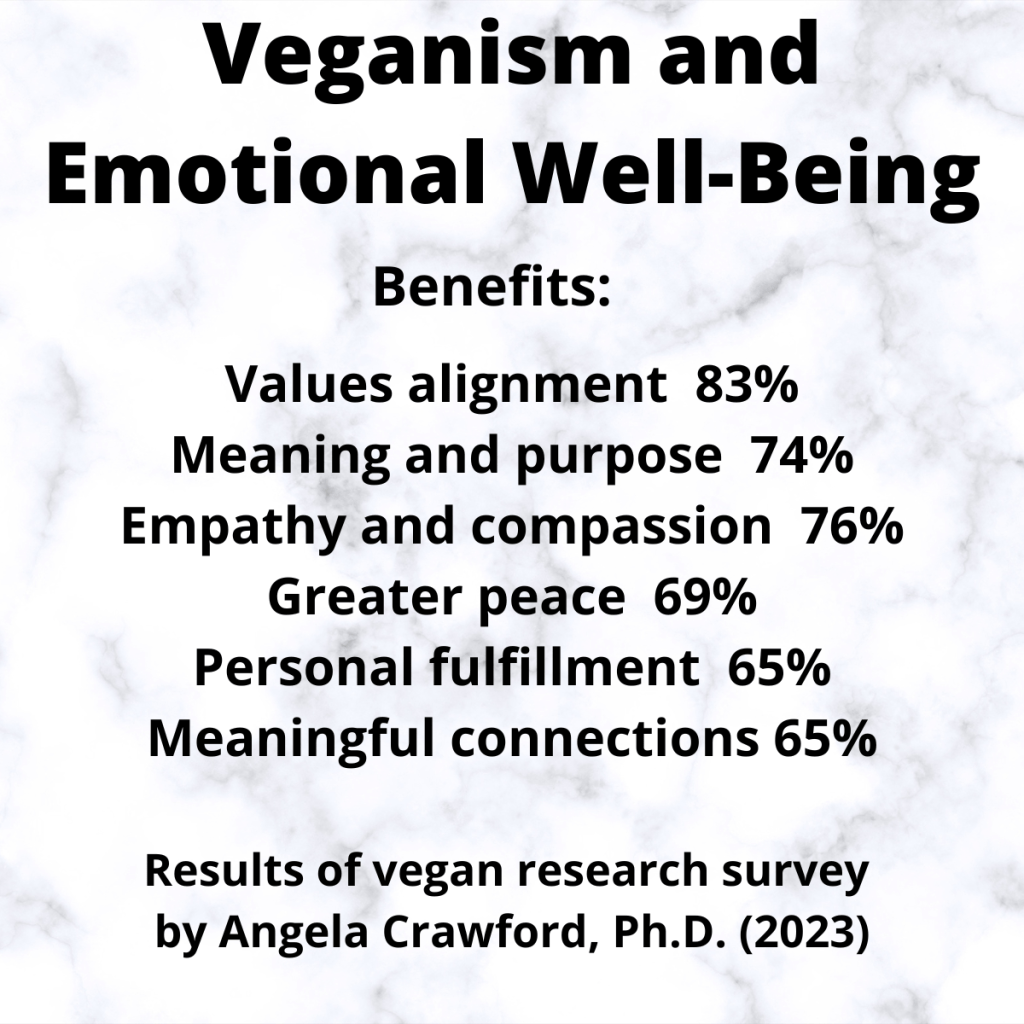
In my book research on the transformative impact of a vegan lifestyle, my research participants reported that being vegan has led to greater peace, fulfillment, and sense of meaning and purpose.
Below are seven ways that veganism can contribute to fulfillment and well-being:
Eating a nutrient-rich, plant-exclusive diet nourishes your body, increases vitality, and reduces your risk of many chronic medical conditions. A plant-powered diet is also anti-inflammatory, which supports your cognitive, mental, and emotional flourishing.
There is fulfillment in honoring your deepest values, which for most of us includes compassion for animals. Once we make the choice to no longer turn a blind eye to the plight of farmed animals – and no longer contribute to their suffering through what we eat – we experience peace and freedom.
Being plant-based is the most powerful way to live sustainably and reduce your environmental footprint. Animal agriculture has a devastating impact on greenhouse gases, water and land usage, pollution, and deforestation. By changing to a plant-based diet (no meat or dairy), you can save 1500 gallons of water, 30 square feet of forest, and 45 pounds of grain each day. (For more info, check out Eat for the Planet by Nil Zacharias and Gene Stone.)
Vegan food tastes great! There is a common misperception that vegan food is bland, restrictive, or depriving. On the contrary, most vegans find that their food palette expands greatly after becoming vegan. We enjoy foods from the bounty of the plant kingdom – including fruits, vegetables, legumes, whole grains, nuts and seeds, spices, herbs, and condiments. There are countless delicious recipes available – with plant-based versions of your favorite foods from all types of cuisines. And when you don’t feel like cooking, there are awesome veg-friendly restaurants as well as many commercial plant-based items in the grocery store (burgers, pizza, ice cream, and so much more) – cruelty-free and delicious.
Being vegan can lead to a greater sense of meaning and purpose. It’s empowering to realize that every day you can make choices that contribute to a healthier and kinder world, simply through what you choose to purchase and to eat. Many of us become so inspired that we choose careers, volunteer work, or activism to contribute to the well-being of humans, animals, and the planet.
In becoming vegan, you can discover deep and meaningful connections with others throughout the world who share your commitment to non-violence, compassion, and flourishing for all.
When we no longer eat animals, this can awaken us spiritually. Many vegans describe greater connection to their intuition, to nature, to all sentient beings, and to the planet. No longer are we consuming fear, suffering, and death. Now we are free to recognize how we are all connected – and to discover our intricate place in the greater whole. We experience deeper appreciation and gratitude for the awe, wonder, mystery, and beauty of the natural world.
Wherever you are on your journey, I hope you’ll experience the joy and peace of aligning with your deepest values. May you live healthfully, compassionately, and sustainably. And may you discover freedom, healing, and authentic fulfillment on this transformative path.
Check out my resource list for books, websites, cookbooks, and documentaries to support your plant-powered journey.
And for more information on the benefits of a vegan lifestyle for health, animals, and the planet, CLICK HERE.
Angela Crawford, Ph.D. is a psychologist and transformational coach. She is passionate about empowering people to express their authentic voice and purpose in service to their own well-being, all beings, and the planet. Dr. Crawford is certified as a Master Vegan Lifestyle Coach and Educator through Main Street Vegan Academy and has a Plant-Based Nutrition certificate from the T. Colin Campbell Institute for Nutrition Studies at e-Cornell. She is currently doing research for a book on the psychological and emotional impacts of a vegan lifestyle. She serves as a psychology advisor for weDIDit.Health, an on-line community that shares the benefits of a plant-powered lifestyle. She hosts a YouTube channel, The Vegan Transformation.
Becoming vegan has been a path of personal transformation for me. When I learned about factory farming and awoke to the immense suffering of farmed animals, I became determined to make changes in my own life to reflect compassion for all sentient beings. I also wanted to help others move toward and sustain a healthy and compassionate plant-powered lifestyle.
This led to me finding a deeper sense of purpose than I had ever experienced before. I saw that in the choice of what I ate daily, I had power to say No to cruelty and oppression – and “vote” through my choices for a kinder and healthier world.
I also found my Voice. As an introvert, I’ve generally lived a quiet and private life. After becoming vegan a little over 4 years ago, I was trained as a Vegan Lifestyle Coach and Educator through Main Street Vegan Academy (an educational experience I highly recommend). This gave me confidence to share my vegan values with others. I started a blog and website about 3 years ago and began research for a book on the transformative power of a vegan lifestyle. I now speak and teach about the benefits of compassionate vegan living for our emotional, mental, physical, and spiritual well-being.
It gives such deep meaning and fulfillment to live our purpose. And through each of us living our purpose, we contribute to healing our world.
Living our purpose doesn’t mean we will be happy all the time. When we awaken to suffering and injustice, it can be really painful. And yet, research (and personal experience) shows that making choices that are aligned with our values and being guided by our higher purpose is more fulfilling than simply trying to “feel good” all the time.
Here are some keys to living your purpose in a way that is healthy and impactful. You may want to have a journal to write in as you reflect on these ideas and questions.
1) Notice – what are your passions, what do you care about deeply, what intrigues you, and what makes you curious?
2) Also notice what makes you angry – what feels unjust or not right? What problems in the world around you are most upsetting to you? Where do you feel most called to make a difference?
3) Make a list of your gifts, abilities, and skills. Think of all the different areas in your life where you have shared your gifts. Ask others for input – they may see gifts that you overlook because they come so naturally.
4) Where is the intersection between your passions, your gifts, and the issues that most concern you? Create a list of ways that your gifts can be applied to help the causes you care about. Write down all the ideas you can think of… and then see where you feel the most energy and excitement. Choose one idea to start, take one step forward – and see where it leads.
5) Don’t forget your own self-care in the process. When we are empathetic to the suffering of others, we can forget or neglect our own well-being. But to be a sustainable and truly impactful advocate, we must include healthy lifestyle practices, have a good support system, and remember our own limits. We are most effective when we take care of ourselves emotionally and physically. Consider what daily practices will help you stay healthy and well.
6) It helps to be connected to something larger than yourself – whether that be your love of nature, your deepest values, spiritual faith, and/or sense of connection to a Higher Power. For me personally, a strong spiritual faith and trusting my inner guidance have been integral to finding and sustaining my purpose. I also have found that it helps to visualize the compassionate world I hope to see – this helps me to stay connected to my larger vision, even during difficult times. To be even more impactful, connect with others who share your vision – we can accomplish more when we collaborate with others.
The vegans I have met through my research have found countless ways to bring their unique passions and gifts toward their vision and purpose. This includes: Cooking and sharing great vegan food, working for animal protection organizations, coaching, mentoring, activism, gardening, volunteering, creating vegan businesses, artwork, writing, nutritional guidance, and educating others about the benefits of veganism and plant-based living.
There are many ways we can make a difference. Our individual steps may feel small – but when we work together, we create momentum and synergy. As each of us shares our individual gifts, we are part of a greater whole. Together, we can envision and create a more compassionate, healthy, and sustainable world.
Angela Crawford, Ph.D. is a psychologist and transformational coach. She is passionate about empowering people to create healthy, purposeful lives that nurture mind, body, spirit, and the planet. Dr. Crawford is certified as a Master Vegan Lifestyle Coach and Educator (through MSVA), and has a Plant-Based Nutrition certificate (T. Colin Campbell Center for Nutrition Studies at e-Cornell). She is currently doing research for a book on the psychological and emotional impacts of a vegan lifestyle. She serves as a psychology advisor for WeDIDit.Health, an on-line community that shares the benefits of a plant-powered lifestyle. She is also a supporting psychology expert for Compassion Rising, a compassion-based educational program. She hosts a YouTube channel, The Vegan Transformation. For additional resources to support your veg journey (e.g., books, websites, documentaries), CLICK HERE.
We are wired for compassion and empathy. In spite of all the news stories that display the seemingly uncaring aspects of humanity, compassion for others is part of our biological and psychological wiring. Indeed, most of us are deeply concerned when others are suffering – and when possible, want to lessen their suffering.
This includes caring for animals – it breaks our hearts to see animals being harmed or abused.
We adore our companion animals, who are beloved members of the family. We do whatever we can to ensure their well-being, often spending a great deal of time, energy, and money toward this end.
And at the same time, we’ve been conditioned to turn away from the suffering of farmed animals who are part of our food system.
We become numb, desensitized, or blind to the inherent cruelty and suffering of this system.
For most of my life, I was blind to what happened to the animals that became my food. I didn’t allow myself to think about it – perhaps because I didn’t believe I had a choice. I thought animal-based foods were necessary for my health – after all, that is what I was taught in school, by authority figures, and in articles I read.
It wasn’t until I had the experience of eating delicious plant-based food at a conference center that I realized that eating vegan was not only possible but also could be highly enjoyable.
A few months later, I learned about the horrors of factory farming. At that point, I was no longer closed off to learning about what happened to “food” animals – I was deeply compelled to read everything I could about this topic.
I’ll never forget reading Diet for a New America early on my veg journey. As the author, John Robbins, described the conditions in which farm animals lived, the slaughter process, and the health and environmental consequences of animal agriculture, I was greatly distressed. I wondered, how could I have not seen this or known this before?
I made the decision to go vegetarian, and then years later, vegan, and haven’t looked back.
My heightened awareness of the plight of animals in our food system (and other systems such as research) has caused me emotional distress – especially when I acknowledge the scope of suffering caused by animal agriculture (i.e., about 80 billion land animals slaughtered per year worldwide). And yet, awakening my compassion has brought so much that is positive.
I feel more alive, authentic, free, and true to myself since opening my awareness and compassion – and choosing to become vegan.
Many other vegans also report this experience. I have been surveying and interviewing vegans as part of my book research on the emotional, social, and spiritual impacts of a vegan lifestyle. This awakening of empathy and compassion was noted by my research participants as a major factor that has contributed to greater overall psychological well-being.
As expressed by one participant: “My daily life is filled with peace, compassion, and equanimity, knowing that I am not harming other sentient beings.”
Another noted, “I’ve become my best self through empathy.”
Benefits of compassion
Compassion is not only good for those we want to help – but is beneficial for us as well. It is linked to numerous positive psychological outcomes:
Given that compassion is beneficial, and that we are wired to empathize, what blocks our compassion for farmed animals? Below are some of the contributing factors. (To delve into this question more deeply, I encourage you to read Dr. Melanie Joy’s book, Why We Love Dogs, Eat Pigs, and Wear Cows).
We often don’t see the plight of farmed animals. Most slaughterhouses and factory farms are well-hidden from public view. Further, there are ag-gag laws that prevent journalists from taking photos or videos inside these facilities (except for those who courageously film undercover videos).
We are raised and conditioned to develop relationships with certain types of animals, but not others. For example, we are taught to care about the birds who visit our bird feeders but not to think about chickens or turkeys raised for food.
We learn to dissociate animal “products” (e.g., a package of meat in the supermarket) from the living, sentient beings they once were.
Many of our educators, doctors, parents, leaders, and other authority figures have instructed us that we need meat and dairy to thrive.
It can be painful to connect with our compassion and to witness the suffering of others. It moves us out of our comfort zone.
How do we awaken compassion for the animals in our food system?
Below are a few suggestions:
Visit a farm sanctuary. This gives the opportunity to meet farmed animals close-up. You discover firsthand that these sentient beings have personalities, intelligence, feelings, social relationships, and preferences (just as our companion animals do). For me personally, Farm Sanctuary in Watkins Glen, NY has played a huge role in awakening and nurturing my compassion for these rescued animals (and for their brothers and sisters in the food system).
Connect with healthy, positive vegan role models – who show that veganism is not only possible and sustainable, but also transformational. If you don’t know any vegans in your immediate network, join vegan or plant-based groups locally or on-line. Once we have vegan supports, and we learn how to thrive with a plant-based lifestyle, it is easier to open our compassion for the sentient beings in the animal agriculture system. This also empowers us to inspire others to open their hearts as well.
Be compassionate toyourself. It can be challenging to connect with the pain and suffering in the world – and sometimes it can feel like too much. Especially for empaths, who may be greatly impacted by animal suffering and feel responsible for stopping the suffering. Include yourself in your circle of compassion, and prioritize healthy self-care, a good support system, and sustainable ways to act on your compassion. There are many helpful groups and resources to help you with self-care and self-kindness on your journey to living and expressing your compassion. Check out my resource list for books, podcasts, and educational resources.
Reconnecting with my natural compassion was one of the greatest gifts that being vegan has given me. Experiencing compassion for all sentient beings brings more meaning and fullness to our human experience – and moves us toward creating a healthier, kinder, and more sustainable world where all can flourish.
NOTE: An adapted version of this article was published on the Main Street Vegan blog 4/18/2023.
Angela Crawford, Ph.D. is a psychologist and transformational coach. She is passionate about empowering people to create healthy, purposeful lives that nurture mind, body, spirit, and the planet. Dr. Crawford is certified as a Master Vegan Lifestyle Coach and Educator, and has a Plant-Based Nutrition certificate from the T. Colin Campbell Center for Nutrition Studies at e-Cornell. She is currently doing research for a book on the psychological and emotional benefits of a vegan lifestyle. She serves as a psychology advisor for WeDIDit.Health, an on-line community that shares the benefits of a plant-powered lifestyle. She is also a supporting psychology expert for Compassion Rising, a compassion-based educational program.
Like many of us, I have always loved animals. As a child, I adored my pet cat, and I had a family of stuffed dogs that I took with me everywhere. I also didn’t like to see any animal (or insect) suffering – I remember once rescuing a grasshopper that was floating in the lake where I was swimming. I let it jump onto my raft and brought it back to shore.
Even though I loved animals, I was raised to believe that meat and dairy were necessary for my health and well-being. I enjoyed the meals my mother cooked, which generally involved some sort of meat, potatoes, and vegetables in a cheese or butter sauce.
I had little awareness of the animals who were bred, raised, and killed to be part of my daily meals. Growing up in Midwestern farm country, I only saw the cows grazing in the fields. I never saw the concentrated animal feeding operations (CAFOs) – aka factory farms – that were kept out of sight.
In fact, I rarely thought about the fact that meat comes from animals. If this thought did cross my mind, it was fleeting. I did not see any other option. I had no idea what to eat if I stopped consuming meat or dairy. I was not the healthiest eater – often choosing what was convenient, easy, and comforting – fast food, microwave meals, chips, and sweets.
It wasn’t until I was 40 that I had my awakening. I saw a program about meat processing plants that shifted my awareness of the whole animal agriculture process – and I realized I did not want to participate in this anymore.
It was freeing – an epiphany that allowed me to live by values that I had long held. I was able to embrace my compassion. I no longer had to turn away from the truth about animal suffering – so that I could have a hamburger or fried chicken.
And far from being depriving as I had feared, a whole world of abundance opened for me. The very next day after watching that program, I tried out a recipe for roasted red pepper and artichoke lasagna. It was delicious, full of vibrant colors and sumptuous flavors. Wow, who knew I could cook?
I began trying spices, ingredients, and condiments I had never used before. I expanded my food palette and found new freedom, joy, and creativity.
When I stopped eating animals and embraced the bounty of the plant kingdom, I became freed in ways I hadn’t anticipated.
I was freed from past food preferences, habits, and addictions that weren’t healthy for me.
I was freed from an inner weight I hadn’t known I was carrying.
I was freed to find my voice and a deeper sense of purpose.
In more fully living my values of compassion, peace, health, wellness, and sustainability, I become more authentically me.
The peace and freedom that I found through living my vegan values is shared by many other vegans. In fact, in my book research on the transformative impact of a vegan lifestyle, the number one positive impact reported by survey respondents is “being true to inner convictions and values.”
My research participants reported a cascade of positive outcomes from aligning daily choices with vegan values:
Greater peace
Confidence
Integrity
Happiness
Purpose and meaning
Satisfaction
Harmony
Contributing to something greater
Doing the least harm
Freedom from inner conflict
Far from being limiting, restricting, or depriving, becoming vegan often brings a surprising sense of empowerment, fulfillment, and freedom…and the hope that we can unite our common values to create a healthier and more compassionate world.
May you enjoy the peace of embodying the values you hold most dear. And in honoring our shared values, may we create a world of greater health, compassion, sustainability, and flourishing for all.
The research referenced in this article is based on my book research on the emotional, psychosocial, and spiritual impacts of a vegan lifestyle.
Angela Crawford, Ph.D. is a psychologist and transformational coach. She is passionate about empowering people to create healthy lives that nurture mind, body, spirit, and planet. Dr. Crawford is certified as a Master Vegan Lifestyle Coach and Educator, and has a Plant-Based Nutrition certificate from the T. Colin Campbell Center for Nutrition Studies at e-Cornell. She is currently doing research for a book on the psychological and emotional benefits of a vegan lifestyle. She serves as a psychology advisor for WeDidIt.Health, an on-line community that shares the benefits of a plant-powered lifestyle.
It’s time for the annual family Thanksgiving dinner, complete with a turkey in the center of the table. You are newly vegan, distressed about how turkeys and other farmed animals are treated…and wonder how you will handle this.
You decide at the last minute to go to a colleague’s social gathering. Once you are there, you realize that all the food being served is laden with meat or dairy products, and there is nothing vegan for you to eat.
You are passionate about the benefits of veganism – for animals, the planet, and human health – and want to share this with others. But you find that most people don’t want to listen and maybe even get annoyed at you for bringing it up.
Your coworker ridicules you for eating “rabbit food,” and constantly wants to debate you about veganism.
How do we handle these challenging situations? Each situation requires us to connect with what we truly want and need…and to take actions that move us toward meeting these ends.
In each situation, heartful communication is key. Communication that connects us with our selves and with others in meaningful and impactful ways. Communication that creates a space for true connection and true transformation.
Research in the areas of social science, psychology, and biology shows that we are literally wired to need connection with others. And because of our wiring, the fear of being rejected by others is deeply ingrained in us. Even if we aren’t conscious of it, that fear can lurk in our psyche at some deep level and make us reluctant to speak up when there may be conflict or disagreement.
Countless studies show how important social support is for our well-being. In fact, loneliness and isolation can be as detrimental to our health as cigarette smoking, high blood pressure, or lack of exercise. In addition, studies of the Blue Zones find that positive social connections promote longevity and quality of life.
For all these reasons, it’s important that we learn healthy relationship and communication skills. And yet, as vegans, we often face unique social situations that can challenge our sense of connection with others.
Let’s face it – conversations about veganism can elicit strong emotions on all sides. For many non-vegans, social conditioning around food habits, along with the carnisticbelief system that permeates our culture, contributes to strong emotional reactions when talk about diet comes up. And for vegans, heightened awareness of the suffering inherent in animal agriculture often drives intense feelings.
When a conversation triggers strong emotions, it can be hard to access our wise brain. Under these circumstances, it’s typical to go into fight-or-flight mode. Consequently, our blood flow is not going toward the parts of our brain that can respond in nuanced ways, but rather toward our more primitive brain, preparing us to fight or flee. This can play out in wanting to prove our point at all costs (fight), or at the other extreme, shutting down communication (flight). In either case, it’s unlikely that a meaningful conversation is going to happen.
Maybe you’ve experienced this in your communication as a vegan. Think about the scenarios at the beginning of this article. If you’ve been in similar situations, how have you expressed your feelings and perspectives? And how has the other person (or people) responded? If you are like many of us, you may have felt very frustrated and not heard. When we feel not heard or understood, we may find ourselves raising our voice or using more attacking language in how we communicate. And when we express our feelings from that state of mind, often the other person becomes defensive, and the conversation does not lead to any productive solutions or resolution.
We need to have ways to shift out of fight-or-flight mode back into our Wise Brain, so we can integrate mind, body, and spirit together into our words and actions.
How do we do this? The authors of the book Crucial Conversations: Tools for Talking When the Stakes are High suggest that we can shift to our Wise Brain by reflecting on our deeper intentions for the conversation. By connecting with our deeper intentions, and communicating accordingly, we create a greater sense of safety in the interaction. This sense of safety helps to lower defensiveness, and supports a meaningful, impactful, and mutually beneficial conversation.
Here are some tips for creating safe space for effective communication:
Connect with your intentions for the conversation. Ask yourself questions such as: What is the message I want to express? What do I hope to accomplish? What do I want for my relationship with this person? How might I best communicate or express myself to reach my purpose? Asking these questions can help to shift you out of reactivity to your emotionally intelligent Wise Brain.
If you start to notice that you or the other person are becoming defensive, arguing, or shutting down, shift your focus to restoring mutual safety, calm, and connection. This is important, so that both of you can calm your nervous systems and return to meaningful, generative communication. When people feel defensive, or are in fight-or-flight mode, they are not engaged in the part of their brain where learning, change, or productive communication can happen.
To help restore safety, you may want to express your intentions for the conversation, such as creating an environment where you and the other person are each able to express your feelings and perspectives and come to a mutual understanding.
Pay attention to your tone of voice and body language, as these are central to creating safe space for healthy communication.
Once a sense of safety is reestablished, you can return to the topic at hand, as space has now been created for meaningful dialogue. The other person will likely be more open to your message, and perhaps even curious to understand more.
When you express yourself, use I-messages, sharing your own story, feelings, wishes, and needs. No one can argue with your own story and feelings, and this way of sharing allows your listener to feel less defensive, with more curiosity and openness.
Draw on reflective listening, allowing for a flow of information and sharing. Being curious to understand the other person’s perspective (rather than judging or attacking) may bring you to a greater mutual understanding.
Agree to disagree, if needed. Come to a mutually workable agreement, where possible. Recognize that if there isn’t immediate agreement, sometimes you may be planting seeds that lead to new understanding and transformation down the road.
Learning healthy communication skills is an ongoing process. When it comes to emotionally laden conversations, our success starts with calming our nervous system, connecting with our Wise Brain, and creating safe space for dialogue to occur.
Effective communication is key to thriving as a vegan – and to creating a more compassionate, healthy world. Heartful communication allows a flow of information and sharing, and a meeting of hearts and minds. And in that meeting of hearts and minds, true connection and transformation can occur.
Note: This article is based on my recent keynote presentation for www.WeDIDIt.Health, available on YouTube.
Angela Crawford, Ph.D. is a psychologist and transformational coach. She is passionate about empowering people to create healthy, compassionate lives that nurture mind, body, spirit, and planet. Dr. Crawford is certified as a Master Vegan Lifestyle Coach and Educator, and has a Plant-Based Nutrition certificate from the T. Colin Campbell Center for Nutrition Studies at e-Cornell. She is currently doing research for a book on the transformative impact of a vegan lifestyle. She serves as a psychology advisor for WeDIDIt.Health, an online community that shares the benefits of a plant-powered lifestyle.
“Veganism is not an elimination diet, it is a lifestyle filled with happiness, peace, and contentment.” “My health and my whole life have transformed. I feel like I got my life back.” “I’m living a life of ahimsa, doing the least harm to myself, the planet, and all beings.” “I feel lighter in body and soul.”
These are just a few of the comments shared by vegans participating in my book research on the mind-body-spirit impacts of a vegan lifestyle.
My survey respondents reported that their vegan journey brought a greater appreciation for the natural world and all beings that inhabit it. Over and over, participants shared a sense of wonder in realizing the interconnectedness of all life. Over and over, they shared the realization that caring for the well-being of others is deeply connected with their own well-being. And while living this compassionate vegan lifestyle, they found that their own health and vitality significantly improved.
What helps to successfully move toward and sustain a healthy, plant-powered, vegan life?
Here are some of the top suggestions from my survey respondents:
1.Connect with a strong motivation for being vegan.
Whether it is for animals, for justice, for health and fitness, and/or for the environment, regularly connecting with your “Why” helps you to keep going when inevitable challenges and obstacles arise. Check out my article Going Plant-Based: A Revelation for Body, Mind, and Spirit to learn some of the compelling reasons for a vegan lifestyle.
2.Build positive supports.
Ask your family and friends to be allies on your vegan journey. Even if they aren’t willing to go vegan with you, explain the importance of your vegan lifestyle to them, and ask them to support you and back you with this. In addition, connect with like-hearted vegans who share your commitment. Discovering your vegan tribe can be one of the most helpful and meaningful parts of the vegan journey. You can find vegan supports through local or on-line plant-based/vegan communities, groups, or organizations. Taking action through volunteer work (for animals, human health, and/or healing our planet) can also create positive connections and a sense that you are making a meaningful difference.
3. Educate yourself.
Listen to podcasts, read books and articles, take classes, and check out plant-based websites. This helps to stay connected to your motivations for being vegan, as well as to learn practical tips and skills for how to thrive as a vegan. See my Plant-Powered Resources List for helpful websites, books, documentaries, and podcasts to empower your vegan journey.
4.Be proactive with social situations.
To stay the course with a healthy vegan lifestyle, it’s important to take responsibility for your own well-being and not leave things to chance. Plan ahead so that you always have vegan food available, whether you are eating out, travelling, or going to a social gathering. I learned this the hard way, after assuming there would be vegan options available at a restaurant or a social situation – and finding that sometimes there were not. I learned to speak up, call ahead, bring dishes to share at social gatherings, and to always have healthy snacks on hand. (For tips on handling social situations, check out my article Navigating Social Challenges on the Vegan Path).
5.Learn effective communication skills.
Healthy communication and relational skills are extremely important in expressing your wishes and needs as a vegan, as well as in advocating for the benefits of a plant-based, vegan lifestyle. A book that I found really helpful to improve vegan communication skills is Beyond Beliefs by Dr. Melanie Joy. For additional guidance, check out my article 7 Tips for Inspiring Others Toward a Plant-Based Lifestyle.
6. Practice healthy self-care.
Being a resilient, impactful, and healthy vegan means including yourself in your circle of compassion. This means choosing nourishing plant-foods that bring vibrant health and energy, enjoying exercise and movement, spending time in nature, enjoying time with companion animals, renewing through meditation and yoga, and drawing on spiritual resources. My participants noted that these self-care activities were essential for remaining empowered, hopeful, and resilient in their vegan lifestyle.
Incorporating these basic practices on your vegan journey will help you to flourish in mind, body, emotions, and spirit. Your shining example will in turn inspire and empower others, moving us toward a world of compassion, health, sustainability, and flourishing for all.
Angela Crawford, Ph.D. is a psychologist and transformational coach. She is passionate about empowering people to create healthy lives that nurture mind, body, spirit, and planet. Dr. Crawford is certified as a Master Vegan Lifestyle Coach and Educator, and has a Plant-Based Nutrition certificate from the T. Colin Campbell Center for Nutrition Studies at e-Cornell. She is currently doing research for a book on the psychological and emotional benefits of a vegan lifestyle. She serves as a psychology advisor for WeDidIt.Health, an on-line community that shares the benefits of a plant-powered lifestyle.