
Hands forming heart shape with sunset in the background

Plant-Empowered Lifestyle for Heart Health

Hands forming heart shape with sunset in the background
mayur-gala-2podhmrvlik-unsplash

Chronic illness takes a huge toll. I have witnessed its impact on the lives of many of my clients, my parents, and numerous friends and family. For those afflicted with a chronic medical condition, it often takes a toll on their very quality of life—impacting everything from daily activities, to work, to relationships, to finances, to independence and autonomy.

Chronic medical conditions also create a huge societal toll. In the US, we are facing a large-scale health crisis. It affects our country’s economic well-being, as we spend huge amounts on medical care. In fact, the US spends more per capita on health care than any other nation, double that of other industrialized nations. Despite our higher health care spending, Americans have lower life expectancy than other high-income nations.

Cardiovascular disease, in particular, has become epidemic in the US. Over 75 percent of people between ages sixty to seventy-nine, and 90 percent of those over age eighty, are afflicted with some form of cardiovascular disease, according to the American Heart Association (see article by AARP). And research suggests that heart disease often starts when we are young, long before we see any signs of its progression.

Early in my career as a psychologist, I learned about the power of mindset, stress management, exercise, and other lifestyle factors for influencing health, but I had little understanding of the role of nutrition. When I first learned about research by pioneers such as Drs. Neal Barnard, T. Colin Campbell, Dean Ornish, and Caldwell Esselstyn, showing the healing power of a plant-based diet to prevent and reverse many common lifestyle diseases, I was blown away. (See my Plant-Powered Resource page for a list of books and resources that share this research).

Since I have a strong family history of heart disease, I was especially impacted by learning that Drs. Ornish and Esselstyn have shown that even severe coronary heart disease can be reversed (and prevented) through a low fat, plant-based diet. Learning that we aren’t solely at the mercy of genes, circumstances, or the medical system, and that we can take charge of our own health, was eye-opening and empowering.
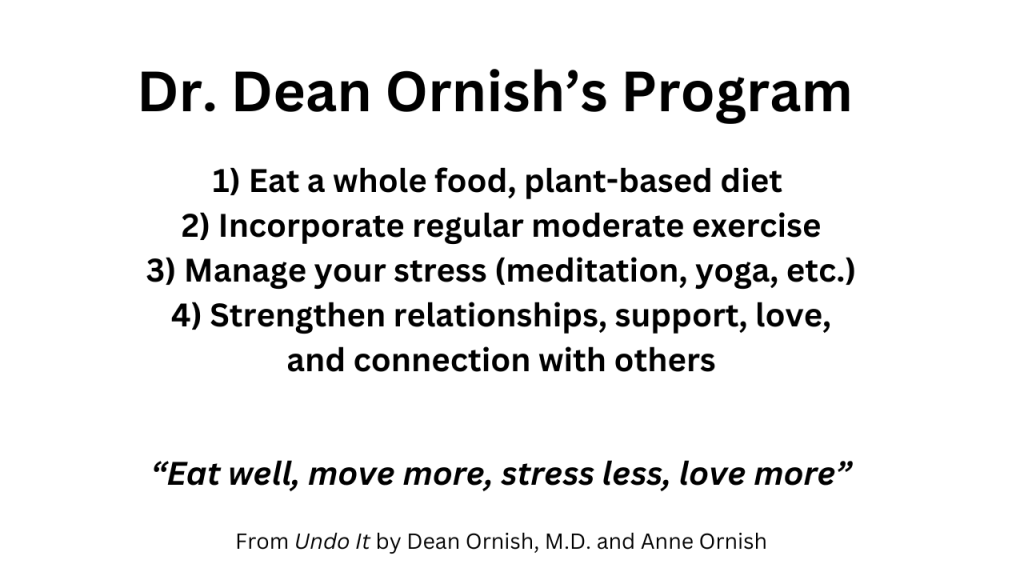
Dr. Dean Ornish has conducted revolutionary research, since the 1980’s, showing that a healthy lifestyle, centered around a plant-based diet, stress management, exercise, and social support, can reverse coronary artery disease, even among those with advanced cases. In addition to improvements in his patients’ physical symptoms, functioning, and well-being, scans of their blood vessels showed reduced blockage and improved blood flow. (For more about Dr. Ornish’s programs and research, read his book, UnDo It, or check out his website).

Similarly, Dr. Caldwell Esselstyn, Jr. conducted research examining the effects of a whole food, plant-based diet for patients with severe coronary artery disease. He found that patients who followed a low fat, plant-based diet showed significant reductions in total cholesterol, LDL cholesterol, coronary events and symptoms, and also evidenced reductions in blockages in their arteries. These improvements enabled his patients to return to previously enjoyed activities and regain their quality of life. (See Prevent and Reverse Heart Disease by Dr. Esselstyn to learn more.)

After my father went through cardiac bypass surgery, I sent him a copy of Dr. Dean Ornish’s cookbook. I don’t think he ever tried the recipes, or significantly changed his diet, although he seemed to appreciate my intentions. (And unfortunately, I lived too far away to share healthy plant-based meals with him on a regular basis). His cardiovascular disease progressed, leading to additional procedures and surgeries. It was heartbreaking to see the impact of these health issues on his life, activities, and independence. My grief was compounded by both parents passing at a younger age than I anticipated due to lifestyle related diseases. Even though I was an adult when I lost them, I felt very much like an orphan after their deaths.

I believe that the loss of my parents played a role in my own desire to be as proactive as possible with my own health, so that I can remain independent, vibrant, and healthy for as long as possible. I have come to realize that we have significantly more personal power over our health than many of us have been told. Rather than clogging our arteries with the Standard American Diet (SAD diet), we can make healthy dietary choices that improve our well-being and decrease our risk for degenerative, lifestyle diseases.

One of the stories I share in my forthcoming book (The Vegan Transformation: A Journey to Heal Yourself and the World) is that of Dr. Akil Taher, a physician, author, and motivational speaker. Dr. Taher began experiencing chest pain in his fifties. Medical testing revealed severe coronary artery blockages, which were addressed by placing stents. Six years later, when the arteries had become narrowed again, he underwent cardiac bypass surgery at age 61. This pivotal experience ultimately led him to adopt a whole-food, plant-based diet. Dr. Taher’s book, Open Heart, chronicles his journey from “couch potato” to running marathons and mountain climbing. His example highlights the profound impact of plant-based diet, mental and emotional resilience, spiritual growth, and finding life’s purpose. He now educates people on preventing and addressing the causes of chronic diseases, rather than treating the consequences of disease after it has happened. (See Dr. Taher’s website to learn more).

It’s empowering to realize that we have more personal power over our health than we have been taught. While we can’t necessarily avoid all illness, we can become informed and make lifestyle choices that support our health. Since learning these connections, it has been part of my mission to empower myself and others toward better physical, emotional, and spiritual health, through the power of a plant-powered, vegan lifestyle.

This passion is one of the reasons I became a licensed PCRM Food for Life instructor and now offer classes on plant-based cooking and nutrition for my online and local communities. Food for Life (FFL) classes promote healthful eating based on the latest scientific research, to help participants reduce their risk for diet-related diseases such as heart disease, diabetes, and cancer. FFL is offered through Physicians Committee for Responsible Medicine (PCRM), a national nonprofit organization that promotes preventive medicine, particularly good nutrition.

Many of us have never learned the power of plant-based nutrition and other healthy lifestyle changes to improve our health and well-being. Once we learn the WHY and the HOW of a healthy, plant-based lifestyle, it can transform our health and our life.

Our health and well-being are among our greatest resources. When we include ourselves in our circle of care, this in turn can empower us to extend our compassion and care to others. Whatever our reasons for moving toward a plant-based lifestyle (whether for personal well-being, animal compassion, and/or the health of our planet), the healthier we are, the greater impact we can have on ALL the things that matter most to us.

NOTE: Segments of this article are adapted from The Vegan Transformation: A Journey to Heal Yourself and the World.

Disclaimer: The information provided in this article and on my website are not intended to be a substitute for professional medical advice, diagnosis, or treatment. Always seek the advice of a qualified health professional with any questions you may have regarding a medical condition. In addition, if you are taking medications for a health condition, it is important to discuss any dietary changes with your physician, as changes in diet may impact the amount of medication needed.

Angela Crawford, Ph.D. is a psychologist, vegan educator, transformational coach, and plant-based culinary instructor. She is author of The Vegan Transformation: A Journey to Heal Yourself and the World (Lantern, April 2025). She also hosts a YouTube channel, @The Vegan Transformation.

Emotional Self-Care for Vegans through the Holidays

Table set with plates, flowers, and blue tablecloth
Photo by Paulette Wooten on Unsplash

While holidays are often a beautiful time of celebration and connection, they can also be rife with family expectations, unhealthy dynamics, and old emotional baggage. These “normal” holiday challenges can be intensified and magnified for those of us living a vegan lifestyle. We may feel like we are walking a delicate tightrope, surrounded by family gatherings, foods, and traditions that don’t align with our values. Under these circumstances, it’s easy to feel isolated, anxious, tense, and even emotionally drained. How can we maintain our peace while honoring our compassionate values? In this article, I discuss three key practices to navigate the holidays with grace and resilience (and maybe even a little joy sprinkled in).

First, before we dive in, I invite you to reflect: What social situations are most challenging for YOU during the holidays? Perhaps you are the only vegan in your family or social circle, and you feel isolated and unsupported. Perhaps you are not sure how to navigate social gatherings centered around animal foods. Or you feel frustrated by family tensions or conflicts. Whatever your holiday challenges, it can be incredibly helpful to proactively develop a plan for how to approach these.

You may wish to grab a note pad or journal to reflect on the questions and suggestions offered below. Consider your personal situation, goals, and desires – and create your own unique holiday self-care “prescription.”

1. Be intentional

Once we become vegan, we see the world very differently than we had previously. We now recognize animal foods (the “centerpiece” of many holiday meals) as the products of suffering, and no longer choose to purchase, eat, or partake in these. As we learn more about the impact of our choices (on animals, humans, the planet, and our own health), we move toward more mindful, conscious, healthy, and compassionate ways of living. Whether others are ready to join us yet or not, we can still be proactive in considering how we want to celebrate. We have the power to influence how our holidays will be.

I invite you to take a moment to envision your ideal holiday season. Take some time to dream and imagine. Who would you spend the time with during the holidays? What kinds of things would you focus on? What foods would you eat? What activities would you engage in? What are the values you want to live by and the mindsets you want to cultivate? Play out an “ideal” holiday, from when you get up to when you go to bed, using all your senses – sights, sounds, sensations, feelings, smells, and tastes.

Now, as you’ve visualized what your ideal holiday might look and feel like, let’s bring it down to a more tangible level. While your vision may or may not fully unfold, there are things you can do to help move in that direction. Reflect on the following questions:

  • What social events and family traditions do you want to continue to be part of?
  • Which events will you choose NOT to attend?
  • What new traditions would you like to create?
  • What vegan foods will you prepare and bring to events?
  • How will you incorporate time for rest, renewal, and self-care?
  • How will you communicate with non-vegan family and friends about the changes you would like to make?

Be creative in exploring solutions that work best for you. It may be as simple as bringing lots of great vegan dishes to social gatherings – ensuring that you have food to eat, while allowing others to discover how scrumptious plant-based cuisine can be. Or you may decline to attend certain gatherings, and instead, plan a vegan meal with friends. Perhaps you might get together with non-vegan family and friends later for a drink, vegan dessert, or movie. Maybe you will schedule some personal time for an activity you love. As you consider these questions and ideas, give yourself time to explore what feels best to you and to discover creative solutions.

2. Emotional self-care

No matter how beautifully you plan your holidays, you’re probably going to experience some anxiety, stress, tension, or frustration at some point. For many of us, holidays are already a stressful time, because there’s so much baggage attached to it. There are family expectations and dynamics, as well as cultural messages and expectations. This “normal” holiday stress can be magnified when we have experienced life changes or losses – or are living and eating differently than the majority of those around us. This means that having an emotional self-care plan for the holidays is essential.

Here again, being proactive can be hugely helpful in preparing for and thriving through the holidays. Take time to reflect (and journal) on the following questions:

  • Which holiday situations do you anticipate will likely bring up stress? How can you prepare for these situations?
  • What plan can you have for handling unexpected stressors? What techniques can you use in the moment to manage stress?
  • How can you implement ongoing self-care to lessen stress?
  • What self-talk and actions will nurture greater self-compassion?
  • How will you nourish yourself physically? (e.g., eating plenty of healthy whole plant foods, exercising, getting adequate sleep).
  • What support systems do you have in place?
  • What pleasurable activities will you enjoy? How can you take time to laugh, play, and enjoy the beauty of life?

Mindful self-awareness is an important foundation for healthy emotional self-care. Consider checking in with yourself periodically to ask these questions: What am I feeling? What do I need? Do I have the energy or bandwidth to continue this conversation or situation right now? Can I take a moment to pause and return to this later? What would nourish me right now, or what might I need to do later?

To navigate emotional stress more effectively, it helps to develop ongoing self-care practices (your self-care “prescription”). Choose a few practices that you are willing to commit to regularly, such as meditation, yoga, affirmations, breathing techniques, taking a walk, time in nature, journaling, time with companion animals, art, or music.

Based on the questions and suggestions above, what daily practices will you implement to relax, manage stress, and process emotions? Write out your holiday self-care prescription, including how and when you will implement these practices. (For additional suggestions, see my recent article on coping with difficult emotions.)

3. Healthy communication

As you explore new ways to navigate the holidays, ultimately you will need to communicate with others about your desired changes. In approaching these conversations, you may wish to reflect: What are creative ways to honor my values AND enjoy meaningful festivities with those I love? How can I communicate this in ways that allow me to be true to myself, while remaining connected to those I care about?

If you are a new vegan, this will include letting those close to you know that you are no longer eating animal products. You may need to explain that you will not be eating Grandma’s beloved pumpkin pie or Uncle Pete’s special pasta Bolognese. It’s important to recognize that for some people, sharing food is their way of sharing love. In these situations, it can be helpful to emphasize that you still love and value the other person(s) and your relationship – and that your decision to go vegan is a personal one, based on values such as ethics or health. You might offer to bring some vegan dishes to share and note that you are happy to provide more information about veganism or plant-based diets if they are interested.

There is an art to effective communication. In some situations, communication flows smoothly and naturally, and you don’t have to give it a lot of thought. However, some conversations can be emotionally charged, and therefore more challenging. Below are some suggestions for navigating these challenging conversations more effectively.

Set an intention for your communication.

The book Crucial Conversations emphasizes the importance of taking time to pause and clarify your intentions and desires before initiating important conversations. This allows you to connect with your Wise Brain, the part of your brain that holds emotional intelligence. Take a deep breath, and then ask yourself questions such as: “What do I really want here – for myself and for the other person? What do I want for the larger situation? What is the best way to express myself to create those results?” This reflection connects you with your deeper wishes, so you can be proactive, not reactive, in how you communicate. It helps to discern the right timing, words, tone, and body language to have a fruitful conversation.

Is your agenda healthy?

In her book, Beyond Beliefs: A Guide to Improving Relationships and Communication for Vegans, Vegetarians, and Meat Eaters, Dr. Melanie Joy discusses the importance of having healthy expectations and intentions for our communication. When we are focused on being “right,” or changing another person, this rarely leads to meaningful communication. Perhaps the healthiest intention for a conversation is greater mutual understanding. We may have secondary goals, but without mutual understanding, our conversation becomes more of a lecture or monologue, not a true interaction. We are each more likely to be touched and moved when we feel heard and understood. Our words will also have more impact, coming from a place of greater understanding and connection.

Communicate assertively, not passively or aggressively.

Assertive communication entails expressing your feelings and needs clearly and directly, in a way that is respectful of the other person as well as yourself. When you communicate assertively, you are honest about what you feel, where you stand, and what you would like to see happen, and at the same time, do this in a way that honors the dignity of the other person. Assertive communication is not just about words, but also about a respectful tone of voice, body language, and manner. It includes using “I-language,” and sharing your perspective and story so that others can better understand where you are coming from. It also involves active listening, to better understand the other’s concerns and perspectives. Assertive communication increases the likelihood of achieving greater mutual understanding and discovering creative solutions.

Passive communication, in contrast, is when we don’t speak up at all, or dance around the issues, rather than be clear and direct. Often this occurs when we are trying to please others or avoid conflict. When we are indirect, this may lead to misunderstandings, and even unintended conflict, because others can’t “read” our desires and intentions.

And then there’s aggressive communication, which comes across as hostile or threatening. It can range from speaking in an angry tone of voice, to name-calling, to verbal attacks, even to physical violence. Those on the receiving end of aggression tend to feel threatened, which triggers a fight-or-flight response, often leading to anger (fight), or to withdrawal (flight). Passive-aggressive behavior is a more subtle form of aggression, which can include sarcasm, ridicule, or sabotaging behaviors. If you’ve ever been on the receiving end of aggressive or passive-aggressive communication, consider how this made you feel. It’s safe to say that this style of communicating rarely lends itself to positive understanding or meaningful change.

Consider: How can you implement intentional, healthy, assertive communication to express your wishes, needs, and/or changes in holiday plans with loved ones? (Check out my Vegan Communication Resource list for additional resources to improve communication.)

Bringing it all together

In this article I’ve discussed three core strategies for navigating the holidays more peacefully: Being intentional and proactive, prioritizing emotional self-care, and implementing healthy communication skills. Developing these skills occurs over time and with practice. While being vegan in a not-yet-vegan world can bring up emotional and interpersonal challenges, it contributes to so much that is positive – for animals, the planet, and for our own health and peace of mind. In honoring our deepest values, and walking the path less traveled, veganism offers an opportunity to live more authentically in our relationship with ourself and with others. Living authentically may ulitimately enable us to navigate the holidays (and beyond) with greater grace, peace, fulfillment, and joy.

Check out my recent presentation on Emotional Self-Care for Vegans (available on YouTube) for additional tips on thriving emotionally through the holidays.

Angela Crawford, Ph.D. is a psychologist, transformational coach, vegan educator, and plant-based culinary instructor. She is author of The Vegan Transformation: A Journey to Heal Yourself and the World (Lantern, 2025).